

Unlike most earthquakes which originate in the earth’s crust at depths of around 10-29km, continental mantle earthquakes originate deep within the planet’s mantle (sometimes, even more than 80km below the Moho discontinuity).
- Earthquakes are the sudden shaking of the Earth’s surface caused by the release of energy in the lithosphere, which creates seismic waves.
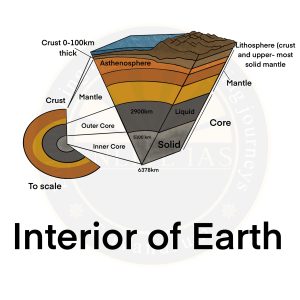
- They occur when tectonic plates, which make up the Earth’s crust, suddenly slip past or collide with each other along fault lines.
What you need to know about continental earthquakes?
- Continental Mantle Earthquakes occur worldwide but are regionally clustered, particularly beneath the Himalayas and the Bering Strait (areas marked by intense continental collision and lithospheric deformation).
- In the case of these earthquakes, surface shaking is usually less severe than shallow quakes of same magnitude because energy dissipates in mantle.
- They are identified by comparing Sn (an S wave that travels through upper mantle) and Lg waves (an S wave that travels through continental crust).
Source: Down To Earth