

The National Education Policy 2020 aims to address issues of quality, equity, access, and affordability across all levels of education. It replaced the 34-year-old NEP of 1986.
- It is based on the recommendations of the Dr. K. Kasturirangan Committee.
- Universalization of Early Childhood Care and Education (ECCE) to Secondary Education by 2030, in line with SDG 4.
- By 2025, the National Mission will have achieved Foundational Learning and Numeracy Skills.
- By 2030, the Pre-School to Secondary Level will be 100% Gross Enrolment Ratio (GER).
- By 2035, higher education will have a 50% GER.
- Bring 2 billion kids back into the mainstream by using the open-schooling method.
- By 2023, teachers must be ready for evaluation reforms, and by 2030, there will be an inclusive and equitable educational system.
Features
- Providing Universal Access at All Educational Levels from Pre-K to Grade 12.
- Ensuring all children between the ages of 0 and 3 receive high-quality early care and education.
- The age ranges for the New Curricular and Pedagogical Structure (5+3+3+3+4) are 3–8, 8–11, 11–14, and 14–18 years, respectively.
- There are no clear boundaries between the arts and sciences.
- Promoting multilingualism and Indian languages is prioritised.
- A new National Assessment Centre called PARAKH (Performance Assessment, Review, and Analysis of Knowledge for Holistic Development) has been established.
- Special Education Zones and a distinct gender inclusion fund for underprivileged areas and organisations.
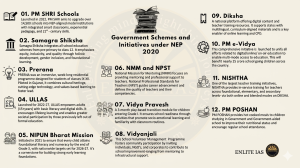
Source: The Hindu