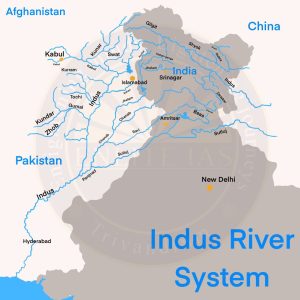
Indus River System (Sindhu River)

  • One of the largest river basins spreads over China(Tibet), India, and Pakistan.
  • It originates from a glacier near Bokhar Chu in the Tibetan region in the Kailash Mountain range near the Mansarovar Lake.
  • River delta near Karachi, Pakistan. 

Himalayan Tributaries of the Indus River

  1. Shyok River: Rising from the Karakoram Range at Rimo glacier. The river widens at the confluence with the Nubra River.
  2. Nubra River: It is the main tributary of the Shyok River. It originates from the Nubra Glacier.
  3. Shigar River: It rises from the Hispar Glacier. It joins Indus at Skardu.
  4. Hunza River: It is an important left-bank tributary of the Gilgit River. It rises from a glacier north of the Karakoram Range in the northwestern part of Jammu and Kashmir.

Indus River Tributaries in the Plains

  1. Chenab River
    • The Chenab originates from near the Bara Lacha Pass in the Lahul-Spiti part of the Zaskar Range.
    • Chenab River is formed by the confluence of the Chandra and Bhaga rivers.
    • It flows through the Jammu region of Jammu and Kashmir into the plains of Punjab in Pakistan
    • The waters of the Chenab are allocated to Pakistan under the terms of the Indus Water Treaty
  2. Jhelum River
    • It is a tributary of the Chenab River
    • The river Jhelum rises from a spring at Verinag situated at the foot of the Pir Panjal range.
    • The waters of the Jhelum are allocated to Pakistan under the terms of the Indus Water Treaty.
    • It flows through the Wular Lake.
    • The Kishenganga River is the largest tributary of the Jhelum.
  3. Ravi River
    • It rises west of Rohtang Pass in the Kullu hills of Himachal Pradesh.
    • The waters of the Ravi River are allocated to India under the Indus Waters Treaty.
    • The major multipurpose project built on the river is the Ranjit Sagar Dam.
  4. Sutlej River
    • It rises from beyond the Indian borders on the southern slopes of the Kailash Mountain from the Rakas lake, which is situated close to the Mansarovar Lake.
    • It enters Himachal Pradesh through Shipki La and flows in the South-westerly direction.
    • The world’s highest gravity dam, Bhakra Nangal Dam, is built on this river.
    • The waters of the Sutlej are allocated to India under the Indus Water Treaty.
  5. Beas River 
    • Beas River emerges from Rohtang Pass in Himachal Pradesh.
    • The tourist resorts of Manali are situated on the right banks of the River Beas.

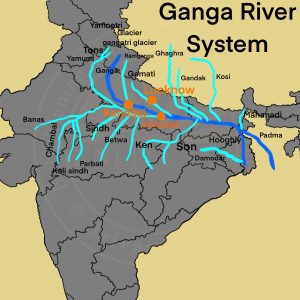
Ganga River System

  • The Ganga River system is spread over India, Tibet, Nepal, and Bangladesh.
  • It is the largest river basin in India and accounts for one-fourth of the total area of the country.
  • Its basin covers the states of Uttar Pradesh, Madhya Pradesh, Rajasthan, Bihar, West Bengal, Uttarakhand, Haryana, Chhattisgarh, Himachal Pradesh, and the UT of Delhi. 
  • Ganga River flows through the states of Uttarakhand, Uttar Pradesh, Bihar, Jharkhand, and West Bengal.
  • The Bhagirathi, considered to be the source stream of Ganga, rises at the foot of the Gangotri Glacier, at Gaumukh.
 

Himalayan Tributaries of the Ganga River

  1. Alaknanda River
    • It rises at the confluence and feet of the Satopanth and Bhagirath glaciers in Uttarakhand.
    • It meets the Bhagirathi River at Devprayag, after which it is called the Ganga.
    • Its main tributaries are the Mandakini, Nandakini, and Pindar rivers.
    • The Hindu pilgrimage centre of Badrinath and the natural spring Tapt Kund lie along the banks of the Alaknanda River.
  2. Bhagirathi River
    • It rises at the foot of Gangotri Glacier, at Gaumukh, at an elevation of 3892m in Uttarakhand.
  3. Dhauliganga River
    • It originates from Vasundhara Tal, perhaps the largest glacial lake in Uttarakhand.
    • Dhauliganga is joined by the Rishiganga river at Raini.
    • It merges with the Alaknanda at Vishnuprayag
    • The Tapovan Vishnugad Hydro Power Project is being constructed on the Dhauliganga River.
  4. Rishiganga River
    • It springs from the Uttari Nanda Devi Glacier on the Nanda Devi Mountain.
    • It is also fed by the Dakshini Nanda Devi Glacier.
    • It flows through the Nanda Devi National Park and merges into the Dhauliganga River

Tributaries of the Ganga River in Plans

  1. Ramganga River
    • Ramganga River originates in the southern slopes of Dudhatoli Hill in Uttarakhand.
    • It also flows through the dun valley of Corbett National Park.
    • It meets the Ganga near Kannauj.
  2. Gomati River
    • It originates from Gomat Taal, Pilibhit in Uttar Pradesh.
    • Meets the Ganges River in Ghazipur.
    • At the Sangam of Gomti and Ganga, the famous Markandey Mahadeo temple is situated.
  3. Ghaghariya  River
    • The Ghagra originates in the glaciers of Mapchachungo.
    • It is a transboundary perennial river originating from the Tibetan plateau near Lake Mansarovar.
    • It is a major left-bank tributary of the Ganga and joins it at Chhapra in Bihar.
    • Rapti, Chhoti Gandak, Sharda, and Sarju are the major tributaries of this river.
  4. Gandak River
    • It is formed by the union of the Kali and Trisuli rivers, which rise in the Great Himalayan Range in Nepal.
    • It enters the Ganga River opposite Patna in a place called Sonepur.
  5. Burhi Gandak River
    • Originates from Chautarva Chaur near Bisambharpur in the district of West Champaran district of Bihar.
    • It flows parallel to and east of the Gandak River in an old channel.
  6. Kosi River
    • Also called Saptakoshi for its 7 Himalayan tributaries.
    • It is an antecedent transboundary river flowing through Nepal and India.
    • The highest peak in the world, Mt. Everest, and the Kanchenjunga are situated in the Kosi catchment.
    • It is also termed “The Sorrow of Bihar”.
  7. Yamuna River System
    • It originates from the Yamunotri Glacier on the southwestern slopes or Bandarpoonch Peak in the Mussoorie range of the lower Himalayas.
    • Flows through the states of Uttarakhand, Himachal Pradesh, and Haryana. It then enters Delhi and merges with the Ganga near Prayagraj.
    • It is the largest tributary of the Ganga in the northern plains.
    • It creates the highly fertile alluvial Yamuna-Ganges Doab region between itself and the Ganges in the Indo-Gangetic plain.
    • The cities of Bhagpat, Delhi, Noida, Mathura, Agra, Firozabad, Etawah, Hamirpur, and Allahabad lie on its banks.
    • Major Tributaries are the Chambal, Banas, Kali  Singh, Ken, Betwa, and Sindh rivers.
  8.  Son River
    • Originates near the Amarkantak hills in Madhya Pradesh
    • It joins the Ganga near Patna in Bihar.

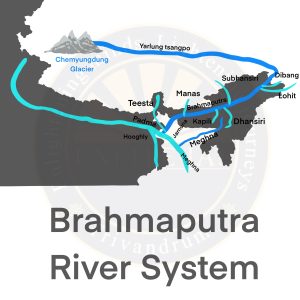
Brahmaputra River System

  • Origin: Chemayungdung glacier in Tibet, China.
  • It flows as the Yarlung Tsangpo River across southern Tibet to break through the Himalayas in great gorges and into Arunachal Pradesh, where it is known as Dihang.
  • The first major tributary is the Raga Tsangpo, meeting the Tsangpo near Lhatse Dzong.
  • West of the town of Sadiya, the Dihang turns to the southwest and is joined by two mountain streams, the Lohit and the Dibang, and below the confluence, the river is known as the Brahmaputra.
  • It flows through Bangladesh as the Jamuna, where it merges with the Ganga (Padma) to form a vast delta, the Sunderbans.
  • The biggest and the smallest riverine islands in the world, Majuli and Umananda, respectively, are situated in the river in the state of Assam.
 

Source: The Indian Express