

General Studies 1
Important Hill Ranges of India: Satpura Range
Satpura range is a series of seven mountains ( sat – seven and pura – mountain) Satpura is taller than the Vindhyas. It runs in an east-west direction, south of the Vindhyas and in between the Narmada and Tapi, roughly … Continue reading
Important Hill Ranges of India: Vindhya Range
The Vindhya Range, overlooking Narmada valley rises as an escarpment (a long, steep slope at the edge of a plateau or separating areas of land at different heights) lying adjacent to the northern edges of Narmada – Son Trough. It … Continue reading
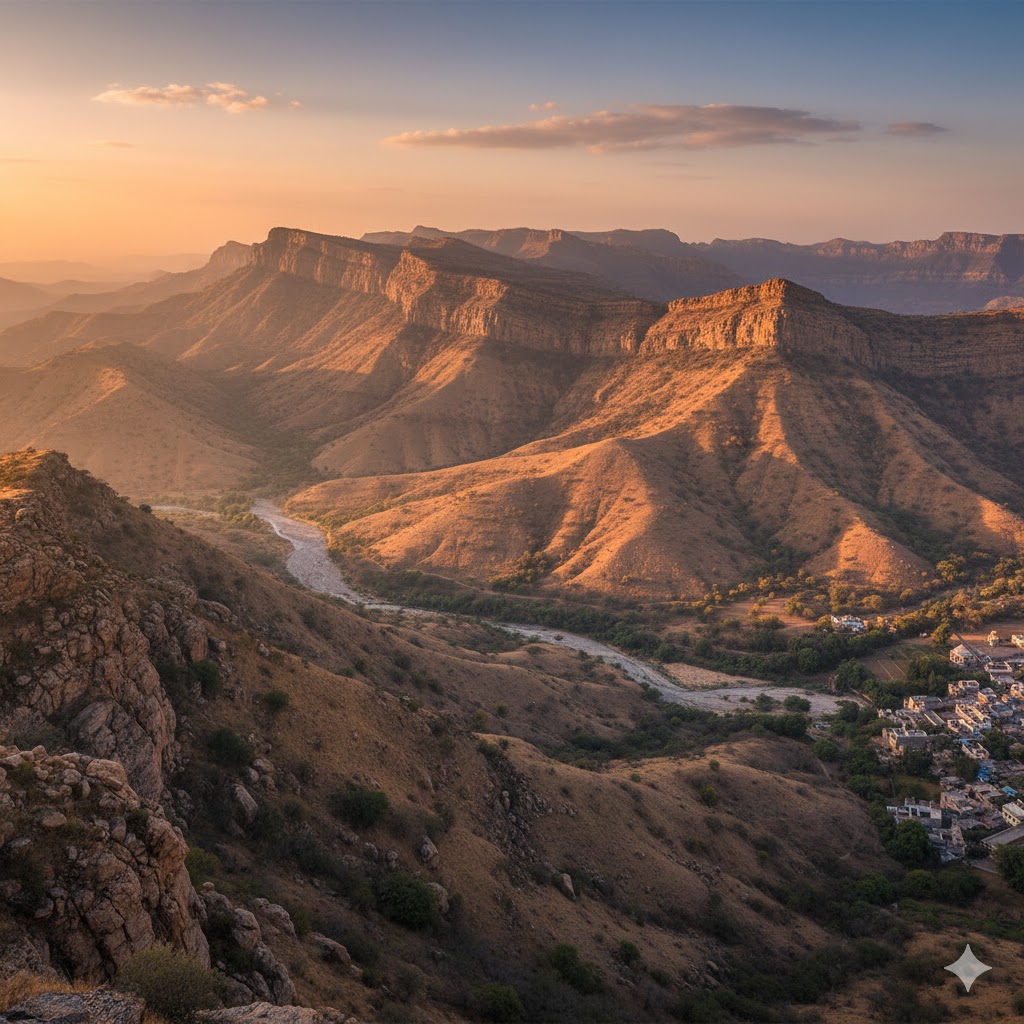
Important Hill Ranges of India: Aravalli Hills
They are aligned in a north-east to south-west direction. They run for about 800 km between Delhi and Ahmedabad in Gujarat, with the width and the height decreasing from Gujarat to Delhi. They are one of the oldest fold mountains … Continue reading
Indian Peninsular Plateau: Division of Deccan Plateau
Maharashtra Plateau It forms the northern part of the Deccan Plateau. Much of the region is underlain by basaltic rocks of lava origin. The area looks like a rolling plain due to weathering. The entire area is covered by black … Continue reading
Indian Peninsular Plateau: Division
Marwar Plateau or Mewar Plateau It is the plateau of eastern Rajasthan. The average elevation is 250-500 m above sea level and it slopes down eastwards. The Banas River, along with its tributaries originate in the Aravali Range and flow … Continue reading
Indian Peninsular Plateau: Basics
The Peninsular Plateau is one of the oldest and most stable landforms of the earth. Roughly triangular in shape with its base coinciding with the southern edge of the great plain of North India. The apex of the triangular plateau … Continue reading
Brahmaputra Plain
This is also known as the Brahmaputra Valley or Assam Valley or Assam Plain as most of the Brahmaputra Valley is situated in Assam. Its western boundary is formed by the Indo-Bangladesh border as well as the boundary of the … Continue reading
Great Indian Plains: Regional Division
Trans Gangetic Plains Rajasthan Plain Rajasthan plain borders the Thar desert (called Marusthali) in the west and Aravallis in the east. This plain is an undulating plain (wave-like) whose average elevation is about 325 m above mean sea level. The … Continue reading
Great Indian Plains: North-South Division of Northern Plains
Bhabhar Region It is a narrow, porous, northernmost stretch of the Indo-Gangetic plain which is located parallel to the Shiwalik foothills. The porosity is due to the deposition of a huge number of pebbles and rock debris across the alluvial … Continue reading
Great Indian Plains: Basics
Origin of Plains The most acceptable version of the origin of plains is that of Edward Suess and his idea of fordeep. The northern part of the peninsular plateau underwent a northward bend and under the thrust of the Eurasian … Continue reading