• The Ganga river system is spread over India, Tibet, Nepal and Bangladesh.
  • It is the largest river basin in India and accounts for one-fourth of the total area of the country.
  • Its basin covers the states of Uttar Pradesh, Madhya Pradesh, Rajasthan, Bihar, West Bengal, Uttarakhand, Haryana, Chhattisgarh, Himachal Pradesh and the UT of Delhi.
  • Ganga river flows through the states of Uttarakhand, Uttar Pradesh, Bihar, Jharkhand, and West Bengal.
  • The Bhagirathi, considered to be the source stream of Ganga rises at the foot of the Gangotri Glacier, at Gaumukh.
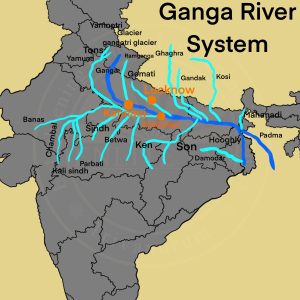
Himalayan Tributaries of Ganga River

  • Alaknanda River
    • It rises at the confluence and feet of the Satopanth and Bhagirath glaciers in Uttarakhand.
    • It meets the Bhagirathi River at Devprayag after which it is called the Ganga.
    • Its main tributaries are the Mandakini, Nandakini, and Pindar rivers.
    • The Hindu pilgrimage centre of Badrinath and the natural spring Tapt Kund lie along the banks of the Alaknanda River.
  • Bhagirathi River
    • It rises at the foot of Gangotri Glacier, at Gaumukh, at an elevation of 3892m at Uttarakhand.
  • Dhauliganga River
    • It originates from Vasundhara Tal, perhaps the largest glacial lake in Uttarakhand.
    • Dhauliganga is joined by the Rishiganga river at Raini.
    • It merges with the Alaknanda at Vishnuprayag
    • Tapovan Vishnugad Hydro Power Project is being constructed on the Dhauliganga.
  • Rishiganga River
    • It springs from the Uttari Nanda Devi Glacier on the Nanda Devi Mountain.
    • It is also fed by the Dakshini Nanda Devi Glacier.
    • It flows through the Nanda Devi National Park and merges into the Dhauliganga River
  • Yamuna River System
    • It originates from the Yamunotri Glacier on the southwestern slopes or Bandarpoonch Peak in the Mussoorie range of the lower Himalayas.
    • Flows through the states of Uttarakhand, Himachal Pradesh, and Haryana. It then enters Delhi and merges with the Ganga near Prayagraj.
    • It is the largest tributary of the Ganga in the northern plains.
    • It creates the highly fertile alluvial Yamuna-Ganges Doab region between itself and the Ganges in the Indo-Gangetic plain.
    • The cities of Bhagpat, Delhi, Noida, Mathura, Agra, Firozabad, Etawah, Hamirpur, and Allahabad lie on its banks.
    • Major Tributaries are Chambal, Banas, Kali  Singh, Ken , Betwa and Sindh rivers.

Tributaries of Ganga River in Plains

  • Ramganga River
    • Ramganga River originates in the southern slopes of Dudhatoli Hill in Uttarakhand.
    • It also flows through the dun valley of Corbett National Park.
    • It meets the Ganga near Kannauj.
  • Gomati River
    • It originates from Gomat Taal, Pilibhit in Uttar Pradesh.
    • Meets the Ganges River in Ghazipur.
    • At the Sangam of Gomti and Ganga, the famous Markandey Mahadeo temple is situated.
  • Ghaghariya River 
    • The Ghagra originates in the glaciers of Mapchachungo.
    • It is a transboundary perennial river originating from the Tibetan plateau near Lake Mansarovar.
    • It is a major left-bank tributary of the Ganga and joins it at Chhapra in Bihar.
    • Rapti, Chhoti Gandak, Sharda, and Sarju are the major tributaries of this river.
  • Gandak River
    • It is formed by the union of the Kali and Trisuli rivers, which rise in the Great Himalayan Range in Nepal.
    • It enters the Ganga river opposite to Patna in a place called Sonepur.
  • Burhi Gandak River
    • Originates from Chautarva Chaur near Bisambharpur in the district of West Champaran district of Bihar.
    • It flows parallel to and east of the Gandak River in an old channel.
  • Kosi River
    • Also called Saptakoshi for its 7 Himalayan tributaries.
    • It is an antecedent transboundary river flowing through Nepal and India.
    • The highest peak in the world, Mt. Everest, and the Kanchenjunga are situated in the Kosi catchment.
    • It is also termed as “The Sorrow of Bihar”.
  • Son River
    • Originates near the Amarkantak hills in Madhya Pradesh
    • It joins the Ganga near Patna in Bihar.

Read More……

Source: The Hindu