

A Tsunami (a Japanese word meaning “harbour wave”) is a series of giant ocean waves caused by a large-scale, sudden displacement of water, usually in an ocean.
Causes of Tsunami
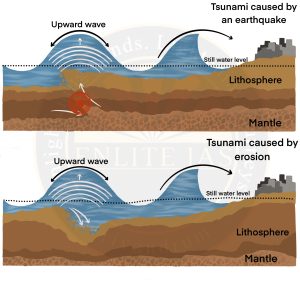
- Undersea Earthquakes (Most Common): Occur primarily at convergent plate boundaries (subduction zones) where one tectonic plate slides under another. The sudden vertical displacement of the seabed displaces the water column above.
- Underwater Landslides: Massive slumping of marine sediments or volcanic flanks displaces water rapidly.
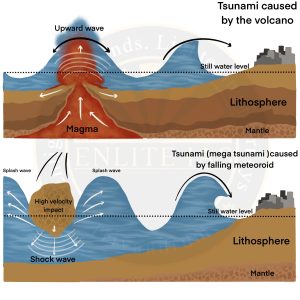
- Volcanic Eruptions: Submarine eruptions or violent coastal eruptions (e.g., the Hunga Tonga-Hunga Ha’apai eruption in 2022) can trigger tsunamis through explosive displacements or caldera collapses.
- Meteorite Impacts: Rare, but highly catastrophic potential causes.
Vulnerable Regions
- Global
- The Pacific “Ring of Fire”: Around 80% of the world’s tsunamis occur here due to intense tectonic activity and subduction zones (e.g., the 2011 Tohoku Tsunami in Japan).
- India
- Andaman-Sumatra Subduction Zone: Triggered the catastrophic December 26, 2004, Indian Ocean Tsunami.
- Makran Subduction Zone: Located in the Arabian Sea (off the coast of Pakistan/Iran).
Management and Mitigation
- India
- ITEWS (Indian Tsunami Early Warning System): Established in 2007, it is operated by the Indian National Centre for Ocean Information Services (INCOIS) in Hyderabad.
- Global
- Sendai Framework for Disaster Risk Reduction (2015-2030): Emphasizes “Building Back Better” and reducing global disaster mortality.
- UNESCO’s “Tsunami Ready” Program: A community performance-based program
Source: The Indian Express