Layers of Atmosphere Based on Temperature and Density
- Troposphere
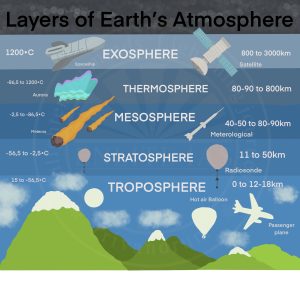
- The troposphere is the lowest layer of Earth’s atmosphere.
- Altitude is 18km at the equator and 8km at the poles.
- Temperature and water vapour content in the troposphere decrease rapidly with altitude.
- The troposphere contains 99 % of the water vapor in the atmosphere.
- All weather phenomena occur within the troposphere.
- The troposphere and stratosphere are separated by a layer called tropopause where temperature is constant.
- Stratosphere
- It extends above the tropopause to an altitude of about 50 km above the planet’s surface.
- The temperature in this layer remains constant for some distance but then rises to reach a level of 0°C at 50 km altitude.
- The temperature rise is due to the presence of ozone which absorbs harmful ultraviolet radiation.
- This layer is almost free from clouds and associated weather phenomena, making conditions ideal for flying airplanes.
- The stratosphere and mesosphere are separated by a layer called stratopause
- Mesosphere
- The mesosphere extends from 50 – 80 km.
- Temperature decreases in this layer.
- Thermosphere
- In the thermosphere, temperature rises with increasing height.
- The ionosphere is a part of this layer which is used for communication.
- It extends between 80-400 km.
- This layer helps in radio transmission.
- Auroras are observed in the lower parts of this layer.
- Exosphere
- This is the uppermost layer of the atmosphere extending beyond the ionosphere above a height of about 400 km.