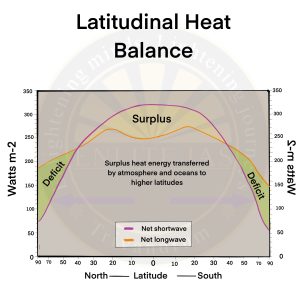
- The amount of insolation received varies from latitude to latitude.
- Regions within the equator and 40° N and S latitudes receive abundant sunlight and hence more heat will be gained than lost. Hence they are energy surplus regions.
- Regions beyond 40° N and S latitudes lose more heat than that gained from sunlight. Hence they are energy deficit regions because of slant sunlight and high albedo of polar regions.
- The atmosphere (planetary winds) and the oceans (ocean currents) transfer excess heat from the tropics (energy surplus region) towards the poles (energy deficit regions) making up for heat loss at higher latitudes.
- And most of the heat transfer takes place across the mid-latitudes (30° to 50°) and hence much of the stormy weather is associated with this region.
- Thus, the transfer of surplus energy from the lower latitudes to the deficit energy zone of the higher latitudes, maintains an overall balance over the earth’s surface.