Definition and Condition
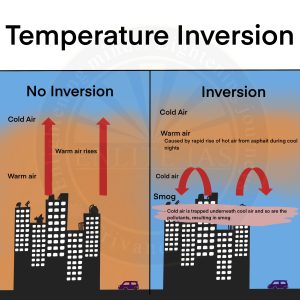
- Definition: A temperature inversion is a layer in the atmosphere in which air temperature increases with height.
- Ideal Condition
- Long nights, so that the outgoing radiation is greater than the incoming radiation.
- Clear skies, which allow unobstructed escape of radiation.
- Calm and stable air, so that there is no vertical mixing at lower levels.
Types of Temperature Inversion
- Surface Temperature Inversion
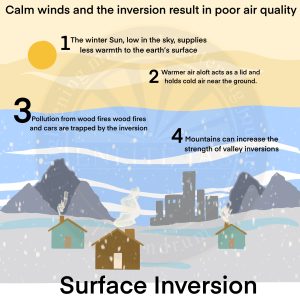
- Surface temperature inversion develops when air is cooled by contact with a colder surface until it becomes cooler than the overlying atmosphere.
- This occurs most often on clear nights, when the ground cools off rapidly by radiation.
- If the temperature of surface air drops below its dew point, fog may result.
- It is very common in the higher latitudes.
- In lower and middle latitudes, it occurs during cold nights and gets destroyed during day time.
- Subsidence Inversion
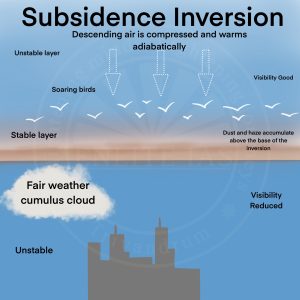
- When a widespread layer of air descends, it is compressed and heated by the resulting increase in atmospheric pressure, and as a result the lapse rate of temperature is reduced.
- The air at higher altitudes becomes warmer than at lower altitudes, producing a temperature inversion.
- This type of temperature inversion is called subsidence inversion.
- It is very common over the northern continents in winter (dry atmosphere) and over the subtropical oceans.
- Valley Inversion
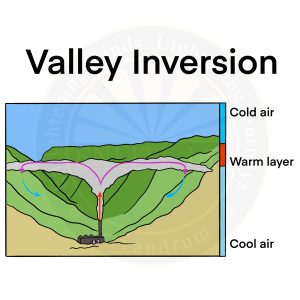
- In high mountains or deep valleys, sometimes, the temperature of the lower layers of air increases instead of decreasing with elevation along a sloping surface.
- Here, the surface radiates heat back to space rapidly and cools down at a faster rate than the upper layers. As a result the lower cold layers get condensed and become heavy.
- The sloping surface underneath makes them move towards the bottom where the cold layer settles down as a zone of low temperature while the upper layers are relatively warmer.
- This condition, opposite to normal vertical distribution of temperature, is known as Temperature Inversion.
- Frontal Inversion
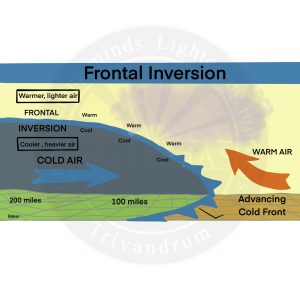
- A frontal inversion occurs when a cold air mass undercuts a warm air mass and lifts it aloft. The front between the two air masses then has warm air above and cold air below.
- This kind of inversion has a considerable slope, whereas other inversions are nearly horizontal. In addition, humidity may be high, and clouds may be present immediately above it.
Effects of Temperature Inversion
- Due to the stoppage of air, dust hangs in the atmosphere.
- Reduction in rainfall because inversion affects the movement of convective clouds.
- It leads to fog formation and low visibility.
- Diurnal variations in temperature tend to be very small.