Atmospheric Pressure
- The weight of the column of air at a given place and time is called air pressure or atmospheric pressure.
- Atmospheric pressure is measured by an instrument called a barometer.
Do You Know?
|
Distribution of Pressure
- Vertical Distribution
- The columnar distribution of atmospheric pressure is known as the vertical distribution of pressure.
- The mass of air above in the column of air compresses the air under it hence its lower layers are denser than the upper layers; As a result, the lower layers of the atmosphere have higher density, hence exert more pressure.
- Conversely, the higher layers are less compressed and, hence, they have low density and low pressure.
- The temperature of the air, the amount of water vapour present in the air, and the gravitational pull of the earth determine the air pressure of a given place and at a given time.
- Since these factors are variable with a change in height, there is a variation in the rate of decrease in air pressure with an increase in altitude.
- Rising pressure indicates fine, settled weather while falling pressure indicates unstable and cloudy weather.
- Horizontal Distribution
- The distribution of atmospheric pressure over the globe is known as horizontal distribution of pressure.
- The horizontal distribution of atmospheric pressure is not uniform in the world. It varies from time to time at a given place; it varies from place to place over short distances.
- Factors Affecting
- Air Temperature
- Earth is not heated uniformly because of unequal distribution of insolation, differential heating and cooling of land and water surfaces
- Air pressure is low in equatorial regions and it is higher in polar regions.
- Low air pressure in equatorial regions is due to the fact that hot air ascends there with a gradual decrease in temperature causing thinness of air on the surface.
- In the polar region, cold air is very dense hence it descends, and pressure increases.
- Earth’s Rotation
- The earth’s rotation generates centrifugal force.
- This results in the deflection of air from its original place, causing a decrease of pressure.
- The low-pressure belts of the subpolar regions and the high-pressure belts of the sub-tropical regions are created as a result of the earth’s rotation.
- Presence of Water Vapour
- Air with a higher quantity of water vapor has lower pressure and that with a lower quantity of water vapor has higher pressure.
- Air Temperature
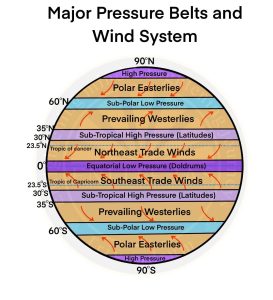
World Pressure Belts
- Equatorial Low Pressure Belts
- Extends from 0 to 5° North and South of the Equator.
- Due to the vertical rays of the sun falling in the region there is intense heating which results in the air expands and rises as convection current causes low pressure to develop here.
- This low-pressure belt is also called doldrums because it is a zone of total calm without any breeze.
- Sub-Tropical High Pressure Belts
- Extend about 30°North and South of the Equator.
- It lies in the area where the ascending equatorial air currents descend. This area is thus an area of high pressure.
- It is also called the Horse latitude.
- Winds always blow from high pressure to low pressure.
- So the winds from the subtropical region blow towards the Equator as Trade winds and another wind blow towards Sub-Polar Low-Pressure as Westerlies.
- Circum-Polar Low Pressure Belts
- These belts located between 60° and 70° in each hemisphere are known as Circum-polar Low-Pressure Belts.
- This zone is marked by the ascent of warm Sub-tropical air over cold polar air blowing from poles. Due to earth’s rotation, the winds surrounding the Polar region blow towards the Equator.
- Centrifugal forces operating in this region create the low-pressure belt appropriately called Circum-polar Low-Pressure Belt.
- This region is marked by violent storms in winter.
- Polar High Pressure Areas
- Extend between 70° to 90° North and South.
- The temperatures are always extremely low.
- The cold descending air gives rise to high pressures over the Poles.
- These areas of Polar high pressure are known as the Polar Highs.
- These regions are characterised by permafrost condition.
Coriolis Effect
|