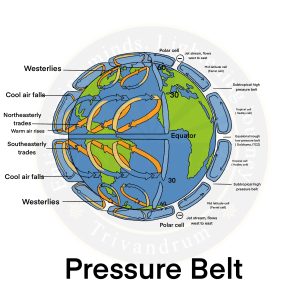
Hadley Cell
- The cell is located between 10-30 degree latitudes in both hemispheres.
- This is a thermally induced cell and is the result of intense solar insolation.
- The intense insolation produces rising air along the equator.
- The rising air cools down below the tropopause and diverges towards the pole as the anti-trade wind.
- They lead to upper air around 30 degrees latitude and sink causing the subtropical high pressure.
- The trade wind flows from this High Pressure toward the equator and completes this cell.
- It is one of the most permanent cells and is associated with a tropical monsoon and desert climate.
Ferrell Cell
- This cell extends from 35 to 60-degree latitude in both hemispheres.
- This is a thermally indirect cell and induced due to dynamic forces. In this cell, the warm air is seen ascending from the polar front and breaking through near the tropopause.
- The most important feature of this cell is that the polar front is more continuous in the middle troposphere.
- There is a subsidence of air in the horse latitude from the tropical as well as polar front dells.
- On the surface, the circulation is completed by the westerly wind blowing toward the poleward side.
Polar Cell
- It extends from 65 to 90 degrees in both hemispheres.
- This is a thermally direct cell and is strongest during winter.
- There is sinking air along the poles which moves towards the subpolar low as the easterly wind.
- In the subpolar lows, the easterly and westerly interact and the air rises to complete the polar cell circulation.