What is it?
- Precipitation refers to all forms of water that fall to the earth from the atmosphere.
- Conditions for precipitation to form
- The atmosphere must have moisture.
- There must be sufficient nuclei present to aid condensation.
- Weather conditions must be good for condensation of water vapour to take place.
- The products of condensation must reach the earth.
Types of Precipitation
- Rain
- Rain is any liquid that drops from the clouds in the sky.
- Raindrops form around microscopic cloud condensation nuclei, such as a particle of dust or a molecule of pollution.
- Rain is described as water droplets of 0.5 mm or larger.
- Drizzle
- It consists of light water precipitation where liquid water droplets are smaller than those of rain.
- This can occur when updrafts in clouds are not strong enough to allow them to produce rain.
- Drizzle usually happens thanks to low-level clouds called ‘stratiform clouds.’
- Drizzle tends to occur more often over colder regions of the subtropics.
- Drop size less than 0.5 mm.
- Snow
- Snow consists of ice crystals in a flaky form, having an average density of 0.1g/cc.
- It is also an important form of precipitation that usually forms in colder climates and higher altitudes.
- Sleet
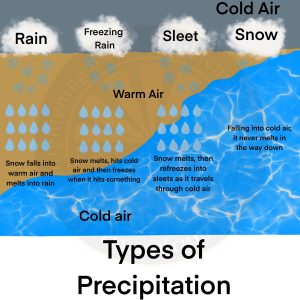
- Sleet is frozen raindrops that are formed when rainfall passes through the air in the atmosphere at subfreezing temperatures.
- It is a type of precipitation in the form of a mixture of rain and snow.
- It is a frozen rain which forms when rain while falling to the earth passes through a layer of the very cold air mass.
- Hail
-
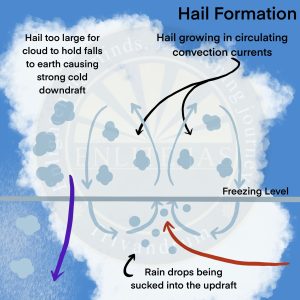
- Hail is a kind of showery precipitation in the form of pellets or lumps that have a size greater than 8mm.
- It falls in the form of small ice pellets.
- The hail consists of concentric layers of ice alternating with layers of snow.
- Its structure resembles that of onion.
- The hail consists of concentric layers of ice alternating with layers of snow. Its structure resembles that of onion.
Types of Rainfall
- Convectional Rainfall
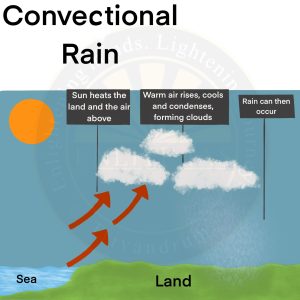
- The air on being heated, becomes light and rises up in convection currents.
- As it rises, it expands and loses heat and consequently, condensation takes place and cumulous clouds are formed.
- This process releases latent heat of condensation which further heats the air and forces the air to go further up.
- Convectional precipitation is heavy but of short duration, highly localised and is associated with minimum amount of cloudiness.
- It occurs mainly during summer and is common over equatorial doldrums in the Congo basin, the Amazon basin and the islands of south-east Asia.
- Orographic Rainfall
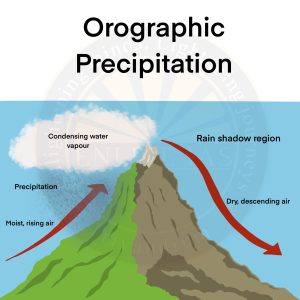
- Orographic precipitation results when warm moist air moving across the ocean is forced to rise by large mountains.
- As the air rises, it cools. As the air cools, the water vapour in the air condenses and water droplets form. Cloud forms and precipitation (rain or snow) occurs on the windward side of the mountain ranges.
- On the windward side also the amount of rainfall starts decreasing after a certain height.
- The air is now dry and rises over top of the mountain. As the air moves back down the mountain, it collects moisture from the ground via evaporation.
- This side of the mountain is called the leeward side which receives very little precipitation.
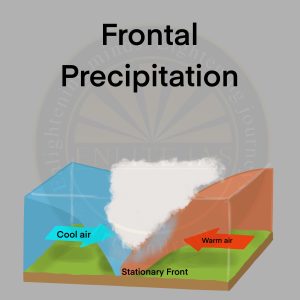
- Frontal Rainfall OR Cyclonic Rainfall
- Cyclonic activity causes cyclonic rain and it occurs along the fronts of the cyclone.
- When two masses of air of unlike density, temperature, and humidity meet then it is formed.
- The layer that separates them is known as the front.
- A warm front and the cold front are the two parts of the front.
- At the warm front, the warm lighter wind increases slightly over the heavier cold air.
- As the warm air rises, it cools, and the moisture present in it condenses to form clouds
- This rain falls gradually for a few hours to a few days.