What is it?
- Tropical cyclones are violent storms that originate over oceans in tropical areas and move over to the coastal areas bringing about large-scale destruction caused by violent winds, very heavy rainfall and storm surges.
Conditions for the Formation of Tropical Cyclones
- Large sea surface with a temperature higher than 27° C.
- Presence of the Coriolis force.
- Small variations in the vertical wind speed.
- A pre-existing weak low-pressure area or low-level-cyclonic circulation.
- Upper divergence above the sea level system.
Stages of Formation
- Formation and Initial Development Stage
- The formation and initial development of a cyclonic storm depends upon the transfer of water vapour and heat from the warm ocean to the overlying air, primarily by evaporation from the sea surface.
- It encourages formation of massive vertical cumulus clouds due to convection with condensation of rising air above the ocean surface.
- Mature Stage
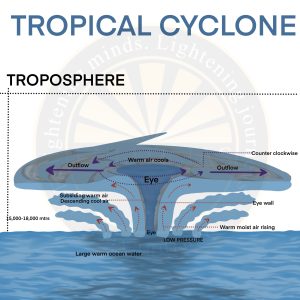
- When a tropical storm intensifies, the air rises in vigorous thunderstorms and tends to spread out horizontally at the tropopause level. Once air spreads out, a positive pressure at high levels is produced, which accelerates the downward motion of air due to convection.
- With the inducement of subsidence, air warms up by compression and a warm ‘Eye’ (Low pressure centre) is generated. The main physical feature of a mature tropical cyclone in the Indian Ocean is a concentric pattern of highly turbulent giant cumulus thundercloud bands.
- Modification and Decay
- A tropical cyclone begins to weaken in terms of its central low pressure, internal warmth and extremely high speeds, as soon as its source of warm moist air begins to ebb or is abruptly cut off.
- This happens after its landfall or when it passes over cold waters.