Factors Affecting Temperature
- Latitude
- The surface temperature of the oceans declines from the equator towards the poles as the Sun’s rays are vertical on the equator and become slanting as one move towards the poles.
- Prevailing Winds
- Direction of the prevailing winds such as the Trade Winds, Westerlies etc., determines the surface temperature of ocean waters by distributing temperature to various parts.
- Unequal Distribution of Land and Water
- Oceans are warmer in the northern hemisphere because the northern hemisphere has more land mass than the southern hemisphere.
- Density of Water
- The density of ocean water is mostly a function of its temperature and salinity. The density of water also varies from latitude to latitude. In the areas of high salinity, the ocean waters are of a relatively higher temperature and vice versa.
- Ocean Currents
- Surface temperature of the oceans is also controlled by cold and warm currents.
- The presence of warm water increases the temperature, and consequently, the rate of evaporation and the region records more rainfall.
- The cold current reduces the temperature of the moisture-laden wind which results in low precipitation and fog formation in coastal regions.
Source of Heat in Oceans
- Insolation and heat from earth’s interior.
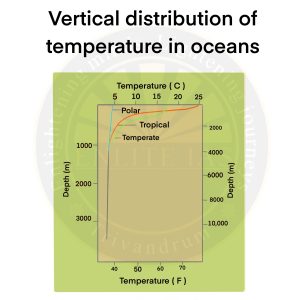
Vertical Distribution of Temperature:
- Only about 45 percent of light energy striking the ocean surface reaches a depth of about one meter, and only 16 percent reaches a depth of 10 meters.
- Three thermal layers of ocean as depth increases
- Photic Zone or Surface Zone
- It is the upper layer of the ocean and temperature is constant.
- It is limited to a depth of about 100 meters.
- Thermocline
- It lies between 100 metres and 1000 metres.
- There is a steep fall in temperature in this zone.
- The density of water increases with increasing depth.
- Depth Zone
- This zone lies below 1000 metres in the mid-latitudes.
- The temperature in this zone remains constant and the temperature is very low.
- Photic Zone or Surface Zone
Horizontal Temperature Distribution of Oceans
- The temperature decreases from equator to poles.
- The temperature of the surface water in the lower latitudes is about 26 degrees Celsius and in the poles it is 0 degrees Celsius.
- The maximum and minimum annual temperatures of ocean water in the Northern Hemisphere are in the months of August and February respectively.
- The average annual range of temperature is about 12 degrees Celsius.
- The highest annual range of temperature is recorded in the North Atlantic Ocean.