Basics
- Definition: Ocean currents are the continuous, predictable, directional movement of seawater driven by gravity, wind, and water density.
- Move in two directions
- Horizontal movements are referred to as currents,
- Vertical changes are called upwellings or downwellings.
Factors Affecting Ocean Currents
- Primary Forces
- Heating by Solar Energy
- Heating by solar energy causes the water to expand. That is why, near the equator the ocean water is about 8 cm higher in level than in the middle latitudes.
- This causes a very slight gradient and water tends to flow down the slope.
- Wind
- Wind blowing on the surface of the ocean pushes the water to move. Friction between the wind and the water surface affects the movement of the water body in its course.
- Gravity
- Gravity tends to pull the water down the pile and create gradient variation.
- Coriolis Force
- The Coriolis force intervenes and causes the water to move to the right in the northern hemisphere and to the left in the southern hemisphere.
- Heating by Solar Energy
- Secondary Forces
- Differences in water density – It affects vertical mobility of ocean currents.
- Temperature of water – Cold-water ocean currents occur when the cold water at the poles sink and slowly move towards the equator.
Types of Ocean Currents
- Based on Depth
- Surface Currents – surface currents constitute about 10 percent of all the water in the ocean, these waters are the upper 400 m of the ocean.
- Deep Water Currents – Deep water currents make up the other 90 percent of the ocean water. These waters move around the ocean basins due to variations in density and gravity.
- Based on Temperature
- Cold Currents
- It brings cold water into warm water areas. These currents are usually found on the west coast of the continents in the low and middle latitudes (true in both hemispheres) and on the east coast in the higher latitudes in the Northern Hemisphere.
- For example – Canary current
- Warm Currents
- It brings warm water into cold water areas and is usually observed on the east coast of continents in the low and middle latitudes (true in both hemispheres).
- For example – Gulf Stream
- Cold Currents
Major Ocean Currents and Deserts
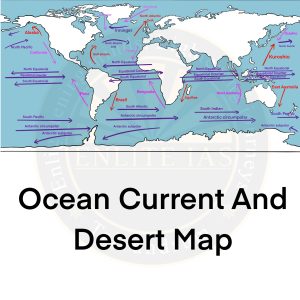
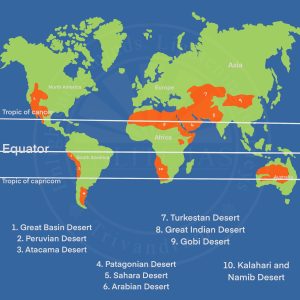
Signification of Ocean Currents
- Climatic
- Mixing of cold and warm current leads to fog formation in the region.
- Cold current leads to desiccating effects resulting in desert formation. For example – Canary current and Sahara desert.
- Economic
- Mixing of warm and cold current leads to plankton growth and mass scale fish production.
- Warm currents like the North Atlantic Drift result in defreezing ports in the north.