What are the Mahajanapadas?
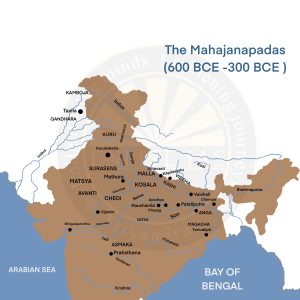
- The Mahajanapadas were 16 large and powerful kingdoms that emerged in ancient India during the 6th century BCE.
- The Mahajanapadas were found in northern and eastern India.
- The modern-day states of Bihar, Uttar Pradesh, Haryana, and Madhya Pradesh were included.
- Magadha, Anga, Kashi, Kosala, Avanti, Vatsa, Gandhara, Kamboja, Chedi, Vajji, Malla, Kuru, Panchala, Matsya, Surasena, and Assaka were among the 16 Mahajanapadas.
- The Mahajanapadas were famous for their illustrious cultural heritage, military might, and economic success.
Political Structure
- Mahajanapadas were republics (Ganas or Sanghas), monarchies, or oligarchies. Most of them were monarchies.
- Monarchies were ruled by a king who wielded supreme power and was assisted by a council of ministers.
- A council of elected members ruled the republics. The executive head was the council’s chairman.
- King had to consult Brahmana, the council of ministers (mantri-parishad), and Rajsabha before making important decisions. He would always be obedient to Brahmanas.
- Oligarchies were ruled by a few people who wielded power over the masses.
- Each of the Mahajanapadas had its capital city.
- The Mahajanapadas had a complex administrative system with several officials holding various responsibilities.
- The king was in charge of the kingdom’s defense, and the army was the state’s backbone.
- The Mahajanapadas had an efficient income collection system. Taxes were collected from a variety of sources.
Socio-Economic Condition
- Nobles, tradesmen, farmers, and workers were among several classes in society.
- During this time, the caste system was not fully evolved.
- Kassaka and ksetrika were terms for common peasants who belonged to the Sudra jati.
- Slavery was common, and slaves were utilized for a variety of manual tasks.
- Marriage alliances were an important component of inter-state interactions, but they were frequently rendered meaningless when it came to achieving political goals.
- Agriculture was the people’s principal activity, and the kingdoms were mostly agrarian.
- The kingdoms had well-established trade routes, and trade and commerce prospered.
- Coinages: The kingdoms issued their own coinage for trade and commerce.
- The coins were often composed of silver or copper, and they were frequently imprinted with symbols and inscriptions that reflected the state’s political and cultural identity.
- The coins were dubbed punch-marked because they were imprinted with a series of symbols and dots punched into the metal.
Reasons That Led to the Development of the Mahajanapadas
- Agricultural Surplus: As agriculture developed, food production rose, resulting in surplus resources. Because of this surplus, certain communities were able to flourish and prosper, resulting in the establishment of increasingly sophisticated governmental institutions.
- Trade and Commerce: The thriving trade routes and economic activities allowed for the buildup of wealth. Control over trade routes and access to lucrative resources were motivations for territorial entity development.
- The decline of the Vedic traditional order caused a power vacuum, resulting in the rise of more organized and centralized governmental organizations. The Mahajanapadas were created in response to the necessity for stronger governmental bodies to keep the peace.
- Conflict over resources: Conflicts arose as a result of rivalry for fertile land, water supplies, and trade routes. The Mahajanapadas were formed in part to address the need for stronger political organizations to preserve and extend territories.
- Population Growth: As the population and towns grew, so did the need for more organized governing systems. Larger societies necessitated more sophisticated administrative structures for resource management and dispute resolution.
- Class Distinctions Emerge: As economies developed, social stratification evolved. As a result, powerful ruling elites rose to solidify their power through political entities.