Basics
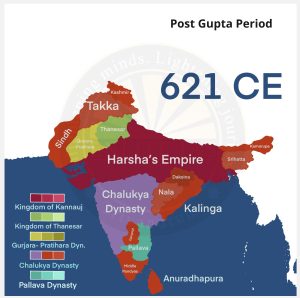
- From 275 CE to 897 CE, the Pallava dynasty ruled much of the Deccan, also known as Tondaimandalam.
- The Pallavas had their capitals at Mahabalipuram (also known as Mamallapuram) and Kanchi.
Important Rulers
- Simhavishnu (575-590 CE)
- Founder of the Pallava dynasty.
- Titles: Avanisimha (lion of the Earth) and Simhavishnupottarayan.
- Court Poet Bharavi wrote Kiratarjuniya (Duel between Shiva and Arjuna).
- Mahendravarman I (600-630 CE)
- Titles:
- Mattavilasa- Addicted to pleasures
- Chitrakarapuli- Tiger among the painters
- Lalitankura- Charming offspring
- Gunabhara- Virtuous
- Chattakari- Temple builder, and
- Vichitrachitta- Curious-minded.
- Killed by Chalukyan King Pulakesin II.
- Under his reign, Tamil literature flourished. Tevaram, for instance, was written by Appar and Sambandhar.
- He is credited with writing the Sanskrit play “Mattavilasa Prahasana.”
- Bodhayan wrote Bhagwatajjukam (a satire).
- Mahendravarman I was a Jainist before switching to Shaivism.
- Mahendra Style: He introduced a new style into Dravidian architecture.
- He mentioned it on a stone inscription in Mamandur, alongside his own Mattavilas Prahasan.
- Monuments in Mamallapuram: Those honoring Shiva were built during his reign.
- Titles:
- Narsimhavarman I (630-668 CE)
- He is regarded as the greatest Pallava ruler.
- He adopted the moniker of Mamalla (great warrior).
- He conquered and murdered Chalukyan ruler Pulakesin II, destroying the Chalukyan city of Vatapi. He assumed the title Vatapikonda (Conqueror of Vatapi).
- Mahabalipuram was a port city constructed by Narsimhavarman I.
- There were seven Ratha Temples during his rule.
- Cholas, Cheras, and Pandyas were all defeated at his hands.
- Ceylon Invasion: He invaded Ceylon (Sri Lanka) twice to assist Manavamma, an exiled Ceylon prince who had approached him for help in securing Ceylon’s throne.
- Hsuen Tsang, a Chinese traveler, paid a visit to Kanchipuram in 642 CE during his reign.
- Narsimhaavarman II (Rajamalla) (695-722 CE)
- Narsimhaavarman II’s reign was peaceful with battles between the Chalukyas and Pallavas coming to an end.
- He sent embassies to China.
- He is responsible for building Mahabalipuram’s well-known Shore Temple, a UNESCO World Heritage site, and the Kailashnath Temple.
- Nandivarman II (731–796 CE)
- The Pallava ruler who had a great influence on both art and architecture was Nandivarman II.
- He is renowned for having supported several rock-cut temples, such as those in Trichinopoly and Mandagapattu.
- Dantivarman (796 – 847 CE)
- He was among the final Pallava kings.
- Due to pressure from the burgeoning Chola dynasty, the dynasty saw a period of collapse under his rule.
- Nandivarman III (850 until 869 CE)
- During his reign, the Pallava dynasty continued to fall while the Cholas grew in power in the area.
Administration
- Pallavas developed agriculture and sea trade, amassing enormous riches, which is reflected in the spectacular temple architecture of the time.
- The Pallava Kingdom was divided into Kottams.
- During the Pallava administration, land concessions were provided to Brahmans (Brahmadeya) and temples Devadhana that were exempt from revenue.
- The group of villages was called ‘Nadu‘.
- The group of Nadus was referred to as ‘Nagaram’ (merchant organization) and the group of Nagarams as ‘Manadalam’.
- Sabhas (assembly) of Brahmin landowners were organized into smaller assemblies/committees that oversaw irrigation, agriculture, roads, and temples.
- Non-Brahmin landowners’ gatherings were known as ‘Ur‘.
- The Pallava inscriptions shed significant insight on village assemblies known as sabhas and associated committees.
Literature
- Kanchi grew into a major center of education, culture, and trade. Kanchi’s Ghatikas (learning centers) were quite popular.
- Pallavas fostered the growth of Tamil language and literature, as well as Sanskrit.
- Patronage for saints resulted in the creation of religious writing.
- Periyapuranam: A collection of Shiva-loving and devotional songs.
- Nalayiram-Divya-Prabandham: A collection of Vishnu-loving and devotional songs.
Architecture and Paintings
- The Pallavas established the Dravidian style of Indian architecture in the South. There was a continuous transition from cave temples to monolithic Rathas, culminating in structure temples.
- Under Pallavas, the main aspects of Dravidian architecture, such as Vimana, Mandapam, and Gopuram, were vividly developed.
- Under Mahendravarman I, miniature rock-cut temples known as Mandapas were built; examples include the Bhairavakona temple and the Anantheshwara temple in Undavalli.
- Narsimhavarman I expanded the mandapas, established Mahabalipuram/Mamallpuram city, and built several monolithic Ratha (Chariot) temples, including the Panchapandavar rathas. Important Mandapams include Varaha, Mahishasuramardhini, and Tirumurthi.
- Narsimhavarman II built Mahabalipuram’s well-known Shore Temple, a UNESCO World Heritage site, and the Kailashnath Temple.
- The Pallavas also contributed to the development of sculpture. Beautiful sculptures cover the Mandapas’ walls.
- The sculpture in Mamallapuram showing the “Descent of Ganges or the Penance of Arjuna” is a work of classical art.
- The paintings in the Sittannavasal caves date back to the Pallava period.
- Mahendravarman I was referred to as Chittirakkarapuli (tiger among painters).
- The Dakshina Chitra (Instruction manual for painters) was compiled during the reign of Mahendravarman I.
Music
- The Kudumianmalai and Thirumayam music inscriptions demonstrate their passion for music.
- Musical instruments included yaazhi, mridangam, and murasu.
- The Mamandur inscription includes information about vocal music notation.
- Both Mahendravarman I and Narasimhavarman I were musical geniuses.
- Dance was popular during the Pallava period, as evidenced by temple sculptures.
Decline of Pallavas
- The Pallava dynasty’s dominance began to diminish in the eighth century when the Cholas and Pandyas seized control of the region.
- Aparajita, the final Pallava ruler, was defeated by Chola king Aditya I, effectively ending the Pallava dynasty’s power.
- Despite their final demise, the Pallavas left a lasting impact on southern India, particularly in the disciplines of art and architecture.
- Today, historians, archaeologists, and art enthusiasts enjoy and study the complex carvings and architectural marvels they constructed.
- The Pallava dynasty’s contributions to Indian culture, as well as its unique architectural style, make it a significant chapter in South Indian history.
- Simhavishnu vanquished Kalabhras and established the rule of imperial Pallavas.
- The Pallavas ascended to power during the reigns of Mahendravarman and Narasimhavarman-I.
- Throughout their rule, they were at odds with the Chalukyas of Vatapi in the north and the Tamil kingdoms of Cholas and Pandyas in the south.
- The Pallavas established their control throughout south Andhra Pradesh and north Tamil Nadu, with Kanchi serving as their capital.
- Kanchi flourished as a temple town and a hub of trade and commerce under their leadership.
- Pallavas are known for their support for the Hindu temple architecture.
- By the time of the Pallavas, the Chalukyas of Badami and the Pandyas of Madurai had started fighting for control of southern India.