Wildlife Sanctuary
- Sanctuary is an area that is of adequate ecological, faunal, floral, geomorphological, natural, or zoological significance.
- The Sanctuary is declared for the purpose of protecting, propagating, or developing wildlife or its environment.
- Wildlife sanctuaries of India are classified as IUCN Category IV protected areas.
- Wildlife (Protection) Act, 1972 provided for the declaration of certain areas by the State government as wildlife sanctuaries if the area was thought to be of adequate ecological, geomorphological, and natural significance.
- The oldest bird sanctuary is Vedanthangal Bird Sanctuary near Chennai in Tamil Nadu state. It was established in 1796.
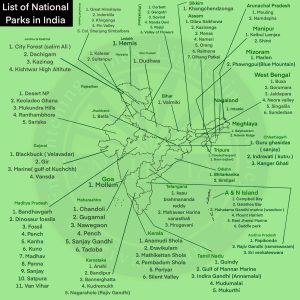
National Park
- The boundaries of National Parks are well defined and no private activities are allowed inside the National Park.
- A national park has more restrictions as compared to a wildlife sanctuary. Their boundaries are fixed and defined.
- They cannot be downgraded to the status of a ‘sanctuary’.
- National parks can be declared both by the Central Government and State governments but National Parks are regulated by the central government.
- National parks in India are IUCN category II protected areas.
- India’s first national park was established in 1936 as Hailey National Park, now known as Jim Corbett National Park, Uttarakhand.
- The Chief Wildlife Warden shall be the authority who shall control, manage, and maintain all protected areas.
Conservation Reserve and Community Reserve
- Conservation reserves and community reserves in India are terms denoting protected areas of India which typically act as buffer zones,connectors, and migration corridors between established national parks, wildlife sanctuaries and reserved and protected forests in India.
- Such areas are designated as conservation reserves if they are uninhabited and completely owned by the Government of India but used for subsistence by communities, and community reserves if part of the land is privately owned.
- These protected area categories were first introduced in the Wildlife (Protection) Amendment Act of 2002, an amendment to the Wildlife Protection Act (WLPA) of 1972.
- These categories were added because of reduced protection in and around existing or proposed protected areas due to private ownership of land, and land use.
- These categories roughly correspond to IUCN Category V (conservation reserves) and VI (community reserves) protected areas.
Sacred Groves
- Sacred groves are communally protected forests which usually have a significant religious connotation for the protecting community.
- The Sacred Groves comprises patches of forest or natural vegetation that are usually dedicated to local folk deities.
- Indian sacred groves are often associated with temples, monasteries, shrines or with burial grounds.
- Hunting and logging are usually strictly prohibited within these patches.
- Other forms of forest usage like honey collection and deadwood collection are sometimes allowed on a sustainable basis.
- The introduction of the protected area category community reserves under the Wild Life (Protection) Amendment Act, 2002 has introduced legislation for providing government protection to community held lands, which include sacred groves.
- Among the largest sacred groves of India are the ones in Hariyali, near Gauchar in Chamoli District of Uttarakhand, and the Deodar grove in Shipin near Shimla in Himachal Pradesh.
- In India, there are over a lakh sacred groves across different states called by different names like Kaavu in Malayalam, Koyil kaadu in Tamil, Orans in Rajasthan, Devara kaadu in Karnataka, and Sernas in Madhya Pradesh.
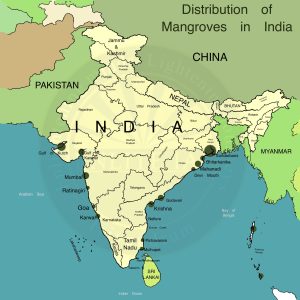
Mangrove
- A Mangrove is a small tree or shrub that grows along coastlines, taking root in salty sediments, often underwater.
- The word ‘mangrove’ may refer to the habitat as a whole or to the trees and shrubs in the mangrove swamp.
- Mangroves are flowering trees, belonging to the families Rhizophoraceae, Acanthaceae, Lythraceae, Combretaceae, and Arecaceae.
- Features
- Saline environment: They can survive under extreme hostile environments such as high salt and low oxygen conditions.
- Low oxygen: Underground tissue of any plant needs oxygen for respiration. But in a mangrove environment, the oxygen in soil is limited or nil.
- Survival in Extreme Conditions: With their roots submerged in water, mangrove trees thrive in hot, muddy, salty conditions that would quickly kill most plants.
- Succulent leaves: Mangroves, like desert plants, store fresh water in thick succulent leaves. A waxy coating on the leaves seals in water and minimises evaporation.
- Viviparous: Their seeds germinate while still attached to the parent tree. Once germinated, the seedling grows into a propagule.