

Chasms
- These are narrow, deep indentations carved out through vertical planes of weakness in the rocks by wave action.
- With time, further headward erosion is hindered by the chasm mouth, which itself keeps widening till a bay is formed.
Sea Cliff
- It is the seaward limit of the coast which is marked by a steep scarp.
- Soft rock erodes quickly and forms gentle sloping cliffs, whereas hard rock is more resistant and forms steep cliffs.
Wave Cut Platforms
- A wave cut platform is a wide gently sloping surface found at the foot of a cliff.
- Condition for formation of wave cut platforms
- The sea attacks the base of the cliff between the high and low water mark.
- A wave-cut notch is formed by erosional processes such as abrasion and hydraulic action – this is a dent in the cliff usually at the level of high tide.
- As the notch increases in size, the cliff becomes unstable and collapses, leading to the retreat of the cliff face.
- The backwash carries away the eroded material, leaving a wave-cut platform.
Caves, Arches, Stacks, and Stumps
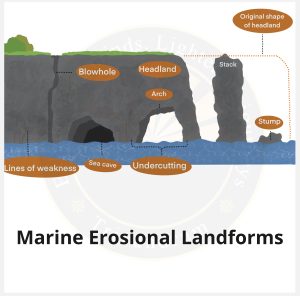
- Caves, arches, stacks and stumps are erosional features that are commonly found on a headland.
- Cracks are widened in the headland through the erosional processes of hydraulic action and abrasion.
- As the waves continue to grind away at the crack, it begins to open up to form a cave.
- The cave becomes larger and eventually breaks through the headland to form an arch.
- The base of the arch continually becomes wider through further erosion, until its roof becomes too heavy and collapses into the sea. This leaves a stack (an isolated column of rock).
- When a portion of the sea arch collapses, the remaining column-like structure is called a stack, skarry or chimney rock.
- The stack is undercut at the base until it collapses to form a stump.
Blow Holes or Spouting Horns
- A narrow fissure through the roof of a sea arch is called a blow hole or a spouting horn because the wave action compresses and squeezes out the air from the sea caves through blow holes making a peculiar noise.
Hanging Valleys
- If the fluvial erosion by streams flowing down the coast is not able to keep pace with the retreat of the cliff, the rivers appear to be hanging over the sea. These river valleys are called hanging valleys.
Ria
- A ria is a coastal inlet formed by the partial submergence of an unglaciated river valley. It is a drowned river valley that remains open to the sea.
Cove
- A cove is a small bay or inlet with a sheltered or restricted entrance. It can also be the entrance to a creek or other small bodies of water.
- Coves are usually formed by the erosion of soft rock formation, leaving hard rock that can form a circular or oval bay with a small entrance.
- A cove is generally less than 1000 feet across and can be much smaller, sometimes less than 100 feet in diameter.
Factors Affecting Marine Erosion
|