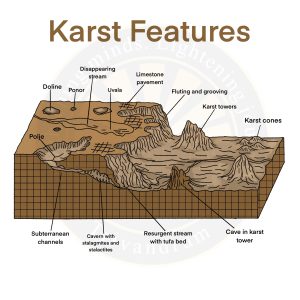
What is it?
- Karst is a topography formed from the dissolution of soluble rocks such as limestone, dolomite, and gypsum.
- It is characterised by underground drainage systems.
- Karst is also most strongly developed where the water table is relatively low, such as in uplands with entrenched valleys, and where rainfall is moderate to heavy.
- For example – The Kwangsi area of China, the Yucatán Peninsula of the US.
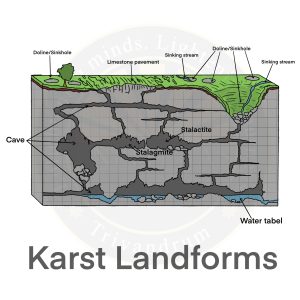
Erosional Landforms
- Blind Valley
- A steephead or blind valley is a deep, narrow, flat bottomed valley with an abrupt ending.
- Swallow Hole
- A sinkhole is also known as a cenote, sink, sink-hole, swallet, swallow hole, or doline.
- It is a depression or hole in the ground caused by some form of collapse of the surface layer.
- It is formed by the chemical dissolution of carbonate rocks or suffosion processes.
- The surface streams which sink disappear underground through swallow holes.
- Clift
- When the Solution hole is dippen over a period of time, then the dipped part is called Clift.
- Pinnacles
- Vertical rock blades fretted and sharped by dissolution.
- Lapies/Karren
- It is formed due to differential solution activity along parallel to sub-parallel joints. They are also called grooved, fluted, and ridge-like features in an open limestone field.
- The most widespread surface karst landforms are small solution pits, grooves, and runnels, collectively called Karren.
- Limestone pavements are a smoother form of lapies.
- Sinking Creeks and Bogas
- In a valley, the water often gets lost through cracks and fissures in the bed. These are called sinking creeks, and if their tops are open, they are called bogas.
- Karst Window and Fenster
- Karst Fenster is a geomorphic feature formed from the dissolution of carbonate bedrock.
- In this case, a spring emerges, then the discharge abruptly disappears into a sinkhole.
- A karst fenster is caused by caving in of portions of the roof of a subterranean stream, thus making some of the underground stream visible from the surface.
- When several adjoining sinkholes collapse, they form an open, broad area called a karst window.
- Uvalas
- Karst depressions that are much larger than sinkholes and that display gentler slopes and are more complex three-dimensional shapes are known as uvalas.
- Uvalas are a collection of multiple smaller individual sinkholes that coalesce into a compound sinkhole.
- Polje
- A polje, also karst polje or karst field, is a large flat plain found in karstic geological regions of the world.
- Pools
- An opening at the top with water collected in the void of the surface with varying depth.
- Caves/Caverns
- This is an underground cave formed by water action by various methods in a limestone or chalk area.