Mushroom Rocks
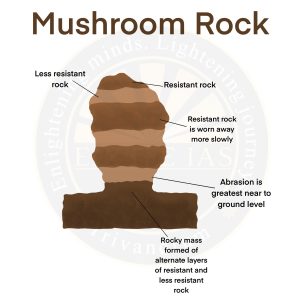
- A mushroom rock, also called rock pedestal or a pedestal rock, is a naturally occurring rock whose shape, as its name implies, resembles a mushroom.
- Formed by the sandblasting effect of winds against any projecting rock masses
Messa and Butte
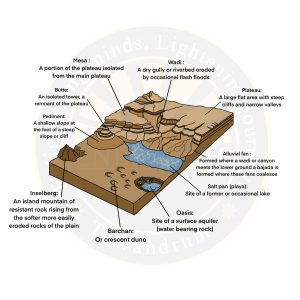
- Mesa
- It is a flat, table-like landmass with a very resistant horizontal top layer and very steep sides.
- The hard stratum on the surface resists denudation by both wind and water.
- Butte
- Continued denudation through the ages may reduce mesas in the canyons and table mountains, so that they become isolated flat-topped hills called buttes.
Zeugen
- ‘Zeugen’ is a word from the German language which means ‘Like Table’.
- When soft rocks covered by hard rocks are eroded by winds, hard rocks left behind look like tables and are known as ‘Zeugen’.
- Their length may vary from 1 metre to 30 metres.
Yardangs
- Yardangs looks quite similar to Zeugen but instead of lying in horizontal strata upon one another, the hard & soft rocks of Yardangs are vertical bands
- Rocks are aligned in the direction of prevailing winds.
- Wind’s abrasion excavates the bands of softer rocks into long, narrow corridors, separating the steep-sided overhand ridges of hard rock called Yardangs.
Isenberg
- They are basically isolated residual hills rising abruptly from the ground level.
- Characterised by very steep slopes and rather rounded tops.
- They are often composed of granite or gneiss.
Ventifacts
- Ventifacts are geomorphic features made of rocks that are abraded, pitted, etched, grooved, or polished by wind-driven sand.
Driekanter
- The direction of winds is never fixed and in the absence of vegetation in a desert, various rocks get eroded continuously in the direction of wind.
- With such continuous and all directional erosion, rocks attain a triangular shape and these are known as Driekanter.
Deflation Hollows
- They are formed where wind has removed sand down to a level where a layer of particles too heavy for the wind to move (an armoured surface) stabilises the sand and prevents the surface being lowered further.
Windows and Bridges
- Window :
- Continuous erosion by high velocity winds forms holes in the rocks and such holes are called Wind Windows.
- Wind Bridges:
- The combined action of deflation and abrasion makes the wind windows larger and wider which assumes an arch like shape with a solid roof over them. Such landforms are called Wind Bridges.
Demoiselle
- With the continuous wind erosion soft rocks are vanished leaving behind the hard rock, which looks like a pillar. This pillar formation is known as Demoiselle.