

Why in the news?
- Kochi hosted the first BIMSTEC-India Marine Research Network (BIMReN) Conference to boost blue economy cooperation.
Bay of Bengal Initiative for Multi-Sectoral Technical and Economic Cooperation (BIMSTEC)
- What is it?: It is a regional organisation that connects South Asia and Southeast Asia, focusing on the Bay of Bengal littoral and adjacent states.
- Formation: Established in 1997 through the Bangkok Declaration.
- Secretariat: Established in Dhaka (2014).
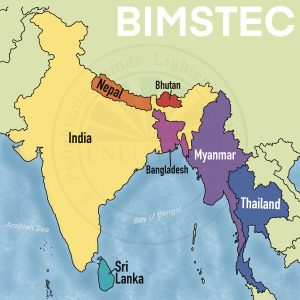
- Objectives
- Creating an enabling environment for the rapid economic development of the sub-region.
- Encouraging the spirit of equality and partnership.
- Promoting active collaboration and mutual assistance in the areas of common interests of the member countries
- Accelerating support for one another in the fields of education, science, and technology, among others.
- Significance of BIMSTEC in the Region
- The BIMSTEC region is home to around 1.5 billion people
- Constitute around 22% of the global population
- Combined Gross Domestic Product (GDP) of 2.7 trillion economy.
- It acts as a bridge between South Asia and Southeast Asia.
- Major Projects
- Kaladan Multimodal Project: Links India and Myanmar.
- Asian Trilateral Highway: Connecting India and Thailand through Myanmar.
- Bangladesh-Bhutan-India-Nepal (BBIN) Motor Vehicles Agreement.
India in BIMSTEC
- Role
- Founding member and major driving force.
- Leads areas like counter-terrorism, environment, and climate change.
- Integrates Neighbourhood First, Act East, and SAGAR policies.
- Significance of BIMSTEC for India
- Geostrategic
- Connects South Asia with ASEAN and the Indo-Pacific region.
- Strengthens India’s presence in the Bay of Bengal, key for maritime security.
- An alternative to the stalled SAARC.
- It counters China’s influence through regional partnerships.
- Economic
- Promotes the BIMSTEC Free Trade Agreement (FTA).
- Supports connectivity projects like the Kaladan Multimodal Project and the India-Myanmar-Thailand Highway.
- Enhances the Blue Economy and trade routes.
- Security
- Cooperation in counter-terrorism, cyber security, and disaster management.
- Enhances maritime domain awareness and regional security cooperation.
- Socio-Cultural
- Boosts tourism, people-to-people ties, and Buddhist circuit development.
- Promotes sustainable development and poverty alleviation.
- Geostrategic
- Challenges
- Delays in Connectivity Projects: Slow progress in Kaladan Multimodal and India–Myanmar–Thailand Highway weakens India’s regional linkages.
- Institutional Weakness: BIMSTEC Secretariat lacks resources and enforcement power, limiting effective implementation.
- Myanmar’s Political Instability: Post-2021 coup crisis hampers India’s land connectivity and security cooperation.
- Low Intra-Regional Trade: Trade integration remains minimal; FTA negotiations are stalled.
- Funding and Resource Constraints: Absence of a dedicated development fund; India bears the main financial load.
- Competing Regional Frameworks: Overlaps with SAARC, ASEAN, and IORA divert attention and dilute outcomes.
- Perception of India’s Dominance: Smaller members sometimes view India as over-influential, affecting trust and cooperation.