

Why in the news?
- The CoP20 CITES has concluded in Samarkand, Uzbekistan, marking the 50th anniversary of the Convention.
Convention on International Trade in Endangered Species of Wild Fauna and Flora (CITES)
- Also known as: Washington Convention.
- Adopted: 1973; Entered into force: 1 July 1975.
- Aim: To ensure that international trade in specimens of wild animals and plants does not threaten their survival in the wild.
- Headquarters: Geneva, Switzerland.
- Secretariat: Provided by the United Nations Environment Programme (UNEP).
- Membership
- Total Members: ~184 Parties (as of 2024).
- India: Became a party in 1976.
- Key Features
- Legally binding: Parties are obligated to adopt domestic legislation to enforce CITES, though it does not replace national laws.
- Trade regulation: Controls trade through a system of permits and certificates.
- Species listings: Species are listed in three Appendices:
- Appendix I: Species threatened with extinction — trade permitted only in exceptional circumstances (e.g., tigers, Asian elephants).
- Appendix II: Species not necessarily threatened but may become so unless trade is strictly regulated (e.g., certain orchids, corals).
- Appendix III: Species protected in at least one country that has requested assistance in controlling trade.
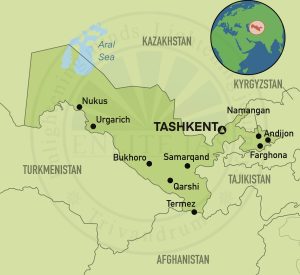
Uzbekistan
- Location: Uzbekistan is a doubly landlocked country located in Central Asia.
- Capital: Tashkent
- Border Countries: Kazakhstan, Kyrgyzstan, Tajikistan, Afghanistan, Turkmenistan.
- Bordering Waterbodies: Aral Sea
- Geography: Part of the Eurasian Steppe or the Great Steppe.
- Climatic Type: Continental Climate
- Major International Groupings: Organisation of Islamic Cooperation (OIC), Shanghai Cooperation Organisation (SCO), and hosts the SCO’s Regional Anti-Terrorist Structure (RATS) in Tashkent.
Source: Down To Earth