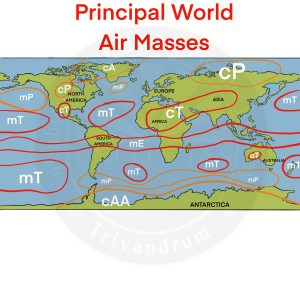
What is it?
- Air mass is a large body of air having nearly uniform conditions of temperature and humidity at any given level of altitude.
- Such a mass has distinct boundaries and may extend hundreds or thousands of kilometres horizontally.
- they are associated with one or other wind belts.
Source Regions
- The homogenous surfaces, over which air masses form, are called the source regions.
- The main source regions are the high-pressure belts in the subtropics (giving rise to tropical air masses) and around the poles (the source for polar air masses).
Conditions for Formation of Air Masses
- The source region should be extensive with gentle, divergent air circulation (slightly at high pressure).
- Areas with high pressure but little pressure difference or pressure gradient are ideal source regions.
- There are no major source regions in the mid-latitudes as these regions are dominated by cyclonic and other disturbances.
Classification of Air Masses Based on Temperature and Humidity
- Polar
- Continental Polar Air Mass (winter time) cPK
- Source regions: Central Canada and Siberia.
- Extremely cold, dry, stable airmass (coldest wintertime airmasses)
- Produce intense cold waves
- No clouds in these air masses.
- Continental Polar Air Mass (summer time) cPW
- Source regions: Central parts of high latitude continents. Example Central Canada
- Cool and dry airmasses
- Steep lapse rates.
- When cPK moves out to oceanic surface, it is modified into cPW air mass with haze, fog and low stratus clouds.
- Maritime Polar Air Mass (winter time) mPK
- It forms over open areas in the higher latitudes cool and moist few clouds in their source regions
- Extensive precipitation is produced when forced to ascend mountain barriers
- Lower layers moist and unstable and dry and cool in upper parts.
- Produce squally weather.
- Maritime Polar Air Mass (summer time) mPW
- Cool and moist in the lower parts, but dry aloft
- Temperature inversion is produced with moisture discontinuity Temperature slightly higher
- Continental Polar Air Mass (winter time) cPK
- Tropical
- Continental Tropical Air mass
- Source regions: Subtropical high pressure land areas
- High temperature and low moisture content.
- In the United States, these air masses are only important in summer. They are both dry in winter and summer.
- In summer they are very hot
- Subsidence and stability found in the upper parts of these air masses in their source regions.
- If cT air mass is aloft over warm moist air at the surface, the atmosphere becomes convectively unstable and violent thunderstorms and tornadoes are produced.
- Maritime Tropical Air Mass (winter time)
- Source regions: Warm oceans in both the hemisphere Warm moist and unstable air masses
- Steep lapse rate up to tropopause and moisture well distributed up to high levels.
- When these air masses are lifted over fronts or high mountains, they produce heavy Precipitation
- Maritime Tropical Air Mass (summer time)
- Source regions located in the belt of great semi permanent highs of the tropical oceans including the Caribbean Sea.
- Continental Tropical Air mass