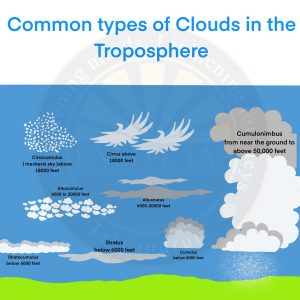
Clouds
- Definition: A cloud is an accumulation or grouping of tiny water droplets and ice crystals that are suspended in the earth’s atmosphere.
- Formation: Clouds are formed when the air becomes saturated or filled, with water vapour. The warm air holds more water vapour than cold air.
- Significance of Clouds
- They are needed for production of precipitation.
- During the nights, clouds reflect heat to the earth and keep the temperature warm.
- During the day, clouds help in keeping the temperature cooler by shielding the sunlight.
- Researching and studying clouds helps in understanding weather and climate.
Classification of Clouds
- Classification Based on Shape
- Cirrus Clouds
- Cirrus clouds are formed at high altitudes of 8,000 – 12,000m.
- They are detached thin clouds.
- They have a feathery appearance.
- They are always white.
- Cumulus Clouds
- Cumulus clouds are generally formed at a height of 4,000 m – 7,000 m.
- They look like cotton wool.
- They exist in patches and can be seen dispersed here and there.
- They have a flat base.
- Stratus Clouds
- Stratus clouds are horizontal.
- Stratus clouds are stratified or layered clouds covering big portions of the sky.
- These clouds are usually formed due to the mixing of air masses with various temperatures or due to loss of heat.
- The presence of stratus clouds means chilly.
- Nimbus Clouds
- Nimbus clouds are usually formed at lower altitudes.
- The colour of Nimbus clouds is usually black or dark grey.
- These types of clouds usually cause heavy rainfall and thunderstorms.
- Cirrus Clouds
- Classification of Clouds Based on Altitude
- High Clouds
- They can reach above 6000 metres or 20,000 feet.
- They are also known as Cirrus Clouds.
- They are usually thin and are made up of ice.
- They often indicate fair weather and hence do not produce rain.
- High Clouds
| Type of cirrus clouds | Features |
| Cirrus |
|
| Cirrostratus |
|
| Cirrocumulus |
|
-
- Middle Clouds
- They are found from 2000 to 6000 metres.
- They are also known as “Alto” clouds.
- They frequently indicate an approaching storm.
- They may sometimes produce Virga, which is a rain or snow that does not reach the ground.
- Middle Clouds
| Type of Alto Clouds | Features |
| Altostratus |
|
| Altocumulus |
|
-
- Low Clouds
- They are found from the surface to 2,000 meters.
- They are also known as Stratus Clouds.
- They may appear dense, dark, and rainy (or snowy) and can also be cottony white clumps interspersed with blue sky.
- Low Clouds
|
Type of Stratus Clouds |
Features |
| Strato Cumulus |
|
| Stratus |
|
| Nimbostratus |
|