

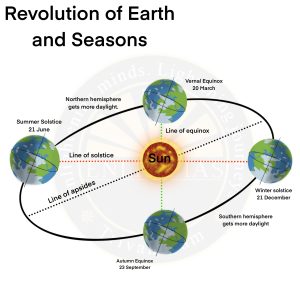
An equinox occurs when the Earth’s axis is not tilted toward or away from the Sun, resulting in equal length of day and night across the planet.
- Equinoxes occur twice a year:
- Vernal Equinox: Around March 20-21, marking the beginning of spring in the Northern Hemisphere and fall in the Southern Hemisphere.
- Autumnal Equinox: Around September 22-23, marking the beginning of fall in the Northern Hemisphere and spring in the Southern Hemisphere.
- On an equinox, the Sun is directly above the Equator, leading to almost equal distribution of sunlight between the Northern and Southern Hemispheres.
- The equal length of day and night is observed, with each lasting approximately 12 hours.
Source: Down To Earth