

A flash flood is a sudden, rapid flooding event that occurs within minutes to a few hours.
- Causes
- Cloudburst or intense localised rainfall.
- Glacial Lake Outburst Floods (GLOFs) in the Himalayan regions.
- Dam or embankment failure.
- Urbanisation leading to impervious surfaces and blocked drainage.
- Deforestation and slope destabilisation in hill areas.
- Areas Generally Affecting
- Hilly Terrain: Flash floods in the Himalayas (Uttarakhand) and Afghanistan.
- Urbanised Region: Flash flood in an urban region like Chennai.
- Arid and Semi-Arid: Rajasthan dry river beds
Glacial Lake Outburst Floods (GLOFs)
A GLOF is a sudden and catastrophic release of water from a glacial lake, typically caused when the natural dam (usually ice, moraine, or landslide debris) containing the lake fails. Example : Example: South Lhonak Lake GLOF, Sikkim (2023)
- Causes
- Glacial melting due to global warming and climate change.
- Earthquakes or landslides can cause a dam breach.
- Ice or rock avalanches into the lake, creating surge waves.
- Sudden glacier calving (chunks breaking off).
- Intense rainfall or rapid snowmelt increases lake volume.
- Unregulated development in glacial valleys.
- Deforestation reducing natural flood barriers.
- Vulnerable Regions in India
- Mostly in the Himalayan States: Uttarakhand, Sikkim, Himachal Pradesh, Jammu & Kashmir, and Arunachal Pradesh.
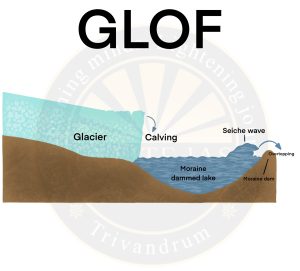
Source: The Hindu