Cirque
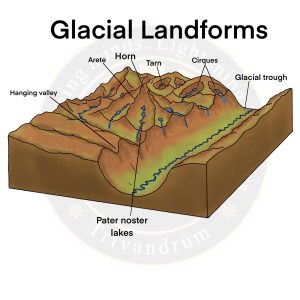
- Cirques are horseshoe shaped, deep, long and wide troughs or basins with very steep to vertically dropping high walls at its head as well as sides.
- Cirques are often found along the head of Glacial Valleys.
- The accumulated ice cuts these cirques while moving down the mountain tops.
- After the glacier melts, water fills these cirques, and they are known as cirque lake.
- It is formed through a process called plucking.
Glacial Trough
- The glacial trough is also called “U” shaped valley.
- They are relatively straight, flat-bottomed, deeper, and steep-sided valleys formed by glacial erosion.
Horns
- Horns form through head-ward erosion of the cirque walls.
- If three or more radiating glaciers cut headward until their cirques meet, high, sharp pointed and steep-sided peaks called horns are formed.
Aretes
- Arete is a narrow ridge of rock which separates two valleys.
- Aretes are typically formed when two glacial cirques erode head-wards towards one another.
- The divides between Cirque side walls or headwalls get narrow because of progressive erosion and turn into serrated or saw-toothed ridges referred to as aretes with very sharp crests and a zig-zag outline.
Fjords
- A fjord or fiord is a long, narrow and steep-sided inlet created by a glacier.
- They are formed where the lower end of a very deep glacial trough is filled with sea water.
- Fjords are common in Norway, Chile, and New Zealand etc.
Hanging Valleys
- A hanging valley is a tributary valley that is higher than the main valley. Hanging valleys are common along glaciated fjords and U-shaped valleys.
- The main valley is eroded much more rapidly than the tributary valleys as it contains a much larger glacier.
- The faces of divides or spurs of such hanging valleys opening into main glacial valleys are quite often truncated to give them an appearance like triangular facets.
Snout or Glacier Terminus
- A glacier terminus, toe, or snout, is the end of a glacier at any given point in time.
- The terminus is usually the lowest end of the glacier.
Cols
- Cols form when two cirque basins on opposite sides of the mountain erode the arête dividing them.
- Cols create saddles or passes over the mountain.
Bergschrund
- At the head of a glacier, where it begins to leave the snowfield of a corrie, a deep vertical crack opens up called a Bergschrund or Rimaye.
- This happens in summer when although the ice continues to move out of the corrie, there is no new snow to replace it.
Nunatak
- A nunatak is the summit or ridge of a mountain that protrudes from an ice field or glacier that covers most of the mountain or ridge.
Crag and Tail
- It is formed from a section of rock that was more resistant than its surroundings.
- Crag is a mass of hard rock with a steep slope on the upward side, which protects the softer leeward slope from being completely worn down by the oncoming ice.
- It therefore has a gentle tail strewn with the eroded rock debris.
Roche Moutonnée
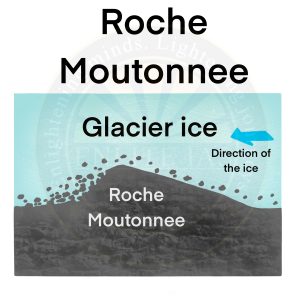
- A resistant residual rock hummock or mound, striated by the ice movement.
- Its upstream or stoss side is smoothed by abrasion & its downward or leeward side is roughened by plucking & is much steeper.
- It is believed that plucking may have occurred on the leeward side due to a reduction in pressure of the glacier moving over the stoss slope.
- Therefore providing the opportunity for water to refreeze on the lee side and pluck the rock away.