

Indus River System (Sindhu River)
- One of the largest river basins spreads over China(Tibet), India, and Pakistan.
- It originates from a glacier near Bokhar Chu in the Tibetan region in the Kailash Mountain range near the Mansarovar Lake.
- River delta near Karachi, Pakistan.
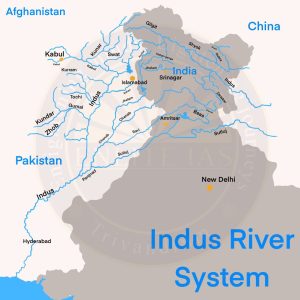
Himalayan Tributaries of the Indus River
Indus River Tributaries in the Plains
|
Ganga River System
- The Ganga River system is spread over India, Tibet, Nepal, and Bangladesh.
- It is the largest river basin in India and accounts for one-fourth of the total area of the country.
- Its basin covers the states of Uttar Pradesh, Madhya Pradesh, Rajasthan, Bihar, West Bengal, Uttarakhand, Haryana, Chhattisgarh, Himachal Pradesh, and the UT of Delhi.
- Ganga River flows through the states of Uttarakhand, Uttar Pradesh, Bihar, Jharkhand, and West Bengal.
- The Bhagirathi, considered to be the source stream of Ganga, rises at the foot of the Gangotri Glacier, at Gaumukh.
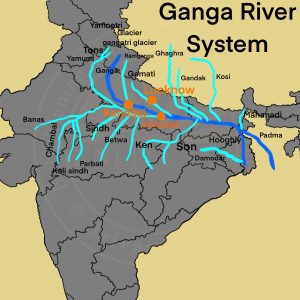
Himalayan Tributaries of the Ganga River
Tributaries of the Ganga River in Plans
|
Brahmaputra River System
- Origin: Chemayungdung glacier in Tibet, China.
- It flows as the Yarlung Tsangpo River across southern Tibet to break through the Himalayas in great gorges and into Arunachal Pradesh, where it is known as Dihang.
- The first major tributary is the Raga Tsangpo, meeting the Tsangpo near Lhatse Dzong.
- West of the town of Sadiya, the Dihang turns to the southwest and is joined by two mountain streams, the Lohit and the Dibang, and below the confluence, the river is known as the Brahmaputra.
- It flows through Bangladesh as the Jamuna, where it merges with the Ganga (Padma) to form a vast delta, the Sunderbans.
- The biggest and the smallest riverine islands in the world, Majuli and Umananda, respectively, are situated in the river in the state of Assam.
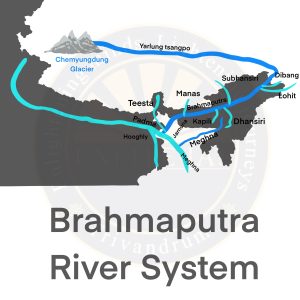
Source: The Indian Express