

Formation of Volcanic Islands
- Hotspot Volcanism: Volcanic islands form when an oceanic plate moves over a stationary mantle plume (hotspot). Repeated eruptions create a chain of volcanic islands, with the youngest island located directly above the hotspot. Example: Hawaiian Islands.
- Divergent Plate Boundary: At divergent boundaries, tectonic plates move apart, allowing magma to rise through the gap and solidify. Continuous volcanic activity can build submarine volcanoes into islands. Example: Iceland on the Mid-Atlantic Ridge.
- Convergent Plate Boundary: At convergent boundaries, one oceanic plate subducts beneath another plate. The subducted plate melts, producing magma that rises to form volcanic island arcs. Examples: Japan, Indonesia, and the Philippines.
Stages of Coral Island Formation
- Volcanic Island Emergence: A submarine volcano erupts and rises above sea level, forming a volcanic island. The island is surrounded by shallow, warm tropical waters suitable for coral growth.
- Fringing Reef Formation: Coral polyps colonize the shallow waters around the volcanic island. A fringing reef develops, attached directly to the island’s coast with little or no lagoon.
- Barrier Reef Formation: The volcanic island gradually subsides (sinks) or sea level rises. Corals continue growing upward toward sunlight. A lagoon forms between the island and the reef, creating a barrier reef.
- Atoll Formation: The volcanic island sinks completely below sea level. Only the ring-shaped coral reef remains, enclosing a central lagoon. This structure is called an atoll.
- Coral Island Formation: Waves and currents deposit coral sand, shells, and reef debris on the atoll. Vegetation gradually establishes itself, leading to the formation of a low-lying coral island.
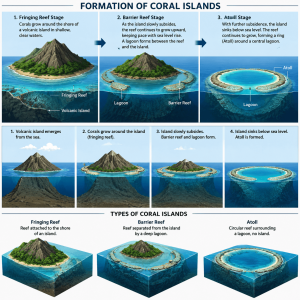
Source: PIB