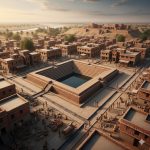
Town Planning
- Grid Layout – The IVC’s cities often had straight, connecting streets and were laid out in a grid-like layout. A clearly defined street grid was made by orienting the streets North-South and East-West.
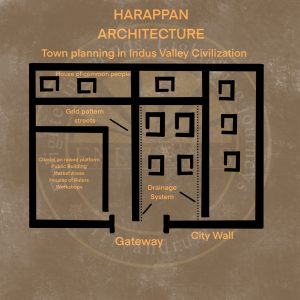
- Uniformity – The standardisation of street widths, brick sizes, and construction methods among the civilization’s cities suggests a high level of centralised planning and power.
- Fortification – There was extensive central planning and control evident in the standardised street widths, brick sizes, and construction methods used in the civilization’s various towns.
- Citadel and Lower Town – A citadel, which is a raised platform or mound, was a common feature of many cities. The citadel probably served as a religious or administration hub. Residential areas, markets, and other facilities could be found in the lower town, which was situated close to the citadel.
- Residential Buildings – The majority of the homes in the city had flat roofs and were constructed of baked mud bricks. Houses were often arranged around tiny passageways. Several rooms, courtyards, and drainage systems were features of certain homes.
- Drainage Systems – The cities of the IVC had remarkably advanced drainage systems. The streets were equipped with covered drains, and houses had their own drainage systems connected to the main street drains.
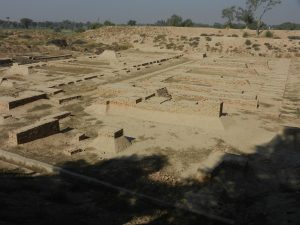
- Great Bath – Probably used for religious bathing
- Granary – Storehouses used to store grains and other foods.
Pic Credit – Wikimedia Commons
Agriculture
- The Region was fertile with alluvial soil due to the presence of the river Indus.
- Wheat, Barley, Rai, Sesame, etc were cultivated.
- The presence of water reservoirs in Dholavira shows water storage for cultivation.
- Terracotta model plough discovered from Banawali, Rajasthan.
Domestication of Animals
- Reared animals like sheep, cattle, goats, pigs, and buffalo.
- Evidence of Rhinoceros from Amri
Trade and Industry
- The discovery of dockyards and wharves suggests that the locals were involved in marine trade.
- IVC artefacts found in far-off places like Mesopotamia suggest the existence of extensive trading networks. Seals written in the Indus script have been discovered in Mesopotamia, indicating that commercial relations went beyond the local region.
- Agricultural items, textiles, pottery, beads, metals (copper, tin, and bronze), ivory, and probably even exotic materials like valuable stones and timber were all traded by the IVC.
- The seals are among the most recognisable items from the IVC. These seals frequently included steatite (soapstone) construction and detailed engravings with pictures of people, animals, and written words. They were probably employed for a variety of things, such as business and administration.
- Standardised weights and measurements point to a well-managed commerce system. These uniform measurements were probably applied to make sure that consistent and fair trade practices were followed.