

- The crust is the outermost solid part and a thin layer of the Earth with an average thickness of 0-50 km.
- The thickness of the crust varies under the oceanic (5 – 30 km) and continental areas (50 – 70 km).
- Nearly 1% of the Earth’s volume and 5% of the Earth’s mass are made of the crust.
- The temperature of the crust increases with depth, reaching levels of around 200°C to 400°C near the mantle-crust boundary.
- Composition
- The crust’s outer layer is made up of sedimentary material, and beneath it are acidic crystalline, igneous, and metamorphic rocks.
- Basaltic and ultrabasic rocks make up the crust’s lowest layer.
- Major Elements of the Crust of crust are Oxygen (O (46.6 %), Silicon (Si) (27.7%), Aluminium (Al) (8.1 %), Iron (Fe) (5.0%), Calcium (Ca)(3.6%), Sodium (Na) (2.8%), Potassium (K) (2.6 %), Magnesium (Mg)(1.5%).
Lithosphere
Asthenosphere
|
Mantle
- The portion of the interior beyond the crust is called the mantle.
- The upper portion of the mantle is called the asthenosphere.
- It is completely solid with a thickness of 10-200 km
- Composition – The mantle has been formed largely of silicate minerals rich in iron and magnesium.
Core
- It is composed of iron and nickel.
- The core lies between 2900 km and 6400 km below the Earth’s surface.
- Divided into
- Outer Core
- Located between a depth of 2900 and 5100km.
- The outer core is liquid because it is not under enough pressure to solidify.
- Inner Core
- The inner core stretches from the Earth’s centre to 5100 kilometres below the surface.
- This layer is solid in nature.
- Outer Core
Discontinuity Between Layers
|
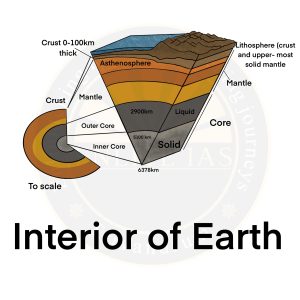
Source: The Hindu