

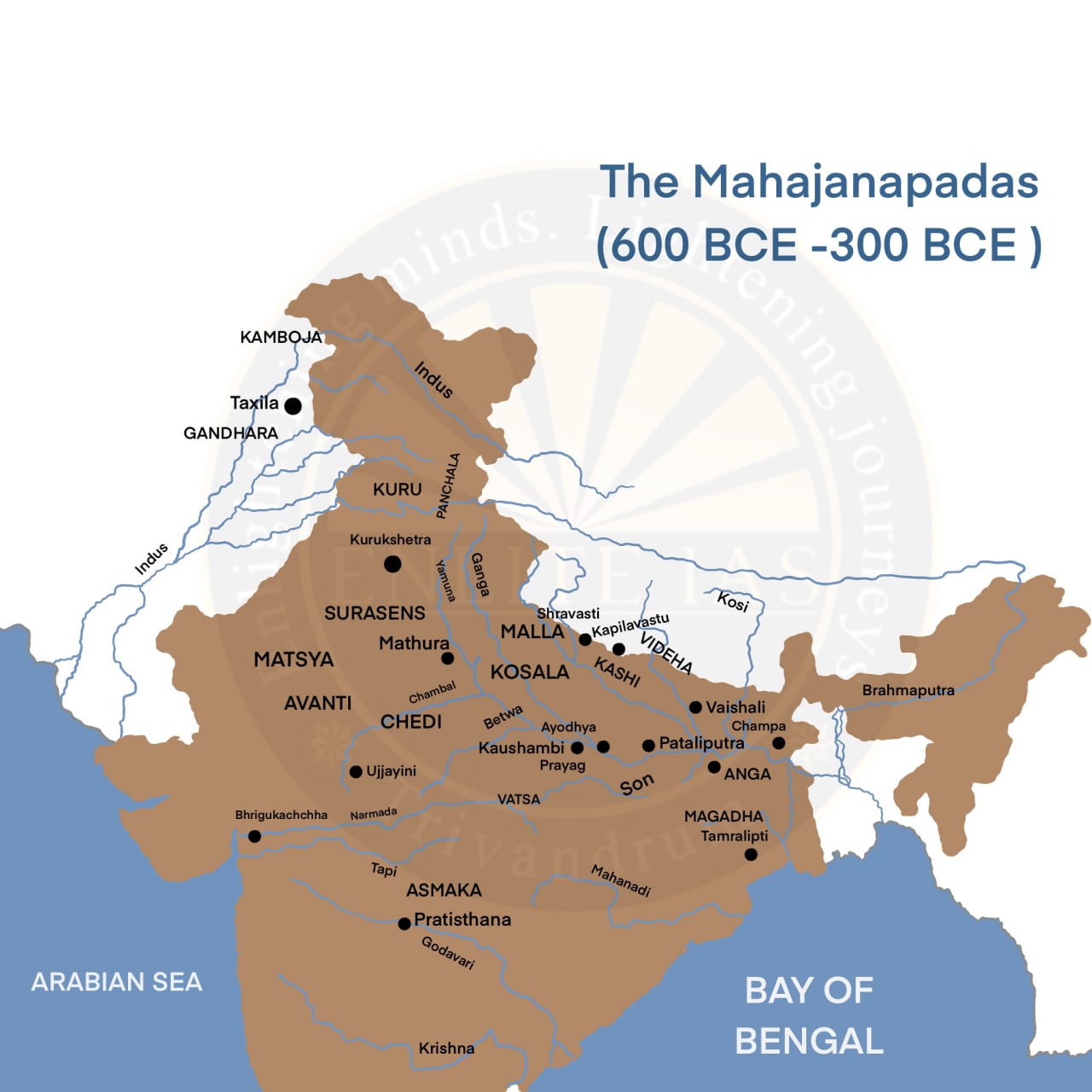
The Mahajanapadas were 16 large and powerful kingdoms that emerged in ancient India during the 6th century BCE.
- The Mahajanapadas were found in northern and eastern India.
- The modern-day states of Bihar, Uttar Pradesh, Haryana, and Madhya Pradesh were included.
- Magadha, Anga, Kashi, Kosala, Avanti, Vatsa, Gandhara, Kamboja, Chedi, Vajji, Malla, Kuru, Panchala, Matsya, Surasena, and Assaka were among the 16 Mahajanapadas.
- Mahajanapadas had monarchies, republics (Ganas/Sanghas), and oligarchies, with monarchies being the most common.
- Monarchies were ruled by a king, assisted by the Mantri-Parishad (Council of Ministers).
- Kings consulted Brahmanas, ministers, and the Rajsabha on important matters.
- Republics were governed by a council or assembly, headed by an executive chief.
- Oligarchies were controlled by a small group of powerful people.
- Each Mahajanapada had a capital city and an organised administrative system.
- The king was responsible for defence, supported by an organised army.
- An efficient tax and revenue collection system supported the administration.
- Society consisted of nobles, traders, peasants, artisans and workers
- The caste system was evolving, and social distinctions became more prominent.
- Kassaka and Ksetrika were terms associated with cultivators or peasants.
- Slavery existed, with slaves employed in manual and domestic work.
- Marriage alliances were used to develop political relations between kingdoms.
- Agriculture was the principal occupation, making the economy predominantly agrarian.
- Expansion of trade routes and urban centres encouraged trade and commerce.
- Punch-marked coins, mainly made of silver and copper, facilitated commercial transactions.
- Coins generally carried symbols and marks punched onto the metal.
Reasons for the Development of Mahajanapadas
- Agricultural Surplus: Increased agricultural production generated surplus and supported larger political units.
- Trade and Commerce: Expansion of trade routes created wealth and encouraged control over important commercial centres.
- Decline of Tribal/Vedic Order: Older tribal political structures gradually gave way to more organised territorial states.
- Competition for Resources: Rivalry over fertile land, water, minerals and trade routes encouraged territorial expansion.
- Population Growth: Increasing population required stronger and more organised administrative systems.
- Urbanisation: Growth of towns created new centres of political and economic activity.
- Social Stratification: Emergence of powerful ruling and wealthy classes strengthened organised political institutions.
- Iron Technology: Iron tools facilitated forest clearance and agricultural expansion, while iron weapons strengthened armies.
Source: The Indian Express