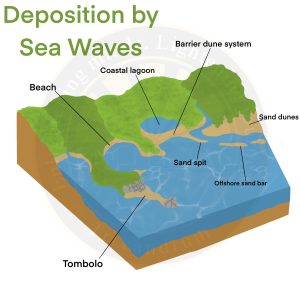
Beaches
- Beaches are made up of eroded material that has been transported from elsewhere and then deposited by the sea.
- For this to occur, waves must have limited energy.
- Constructive waves build up beaches as they have a strong swash and a weak backwash.
- Sandy beaches are usually found in bays where the water is shallow and the waves have less energy.
- Pebble beaches often form where cliffs are being eroded, and where there are higher energy waves.
Spits and Hooks
- A spit is an extended stretch of sand or shingle jutting out into the sea from the land. Spits occur when there is a change in the shape of the landscape or there is a river mouth.
- A shorter spit with one end curved towards the land is called a hook.
Bars and Lagoons
- The longshore currents, tidal currents and the shore drift deposit rock debris and sand along the coast at a distance from the shoreline. The resultant landforms which remain submerged are called bars.
- The enclosed water body so created is called a lagoon.
Barrier
- It is the overwater counterpart of a bar.
Tombolos
- A tombolo is a sandy isthmus which connects islands to mainlands.
Dunes & Dune Belts
- With the force of on-shore winds, a large amount of coastal sand is driven landwards forming extensive marine dunes that stretch into dune belts.
- For example – The Coastal Red Sand Dunes is also known as ‘Erra Matti Dibbalu’.