

- Pillar inscriptions became significant during the Ashoka period.
- Uses of Pillars.
- As a symbol of the State or to commemorate battle victories.
- Also used to propagate imperial sermons as well.
- The material used to build the pillars was chunar sandstone.
- Parts of the Pillars
- The shaft formed the base and was made up of a single piece of stone or monolith.
- On top of it lay the capital, which was either lotus-shaped or bell-shaped and was influenced by Iranian pillars.
- Above it, there was a circular or rectangular base known as the abacus on which an animal figure was placed.
- The abacus and the animal part of the Sarnath pillar form the official national emblem of India.
- Four animals are shown representing four directions.
| Animals | Direction | Representation |
| Galloping Horse | West | The horse named Kanthaka, which Buddha is said to have used for leaving his princely life. |
| Elephant | East | Elephant depicts the dream of Queen Maya, where a white elephant is seen entering her womb. |
| Bull | South | Bull depicts the zodiac sign of Taurus, the month in which Buddha was born. |
| Lion | North | Lion shows the attainment of enlightenment. |
- The four Lions symbolize Buddha spreading Dhamma in all directions.
- It was built in commemoration of the first sermon by Buddha known as Dharmachakrapravartana.
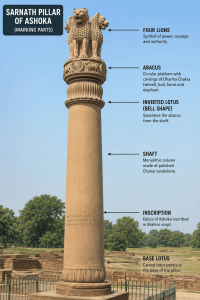
Source: The Indian Express