

- The hypothesis of seafloor spreading was put forward by H. Harry Hess in 1960.
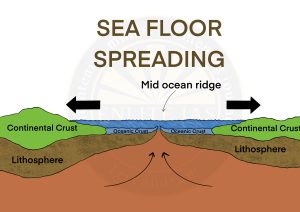
- Seafloor spreading is a process that occurs at mid-ocean ridges, where new oceanic crust is formed through volcanic activity and then gradually moves away from the ridge.
- When oceanic plates diverge, tensional stress causes fractures to occur in the lithosphere.
- Basaltic magma rises from the fractures and cools on the ocean floor to form new seafloor.
- The newly formed seafloor (oceanic crust) then gradually moves away from the ridge, and its place is taken by an even newer seafloor, and the cycle repeats.
- With time, older rocks are spread farther away from the spreading zone, while younger rocks will be found nearer to the spreading zone.
- Evidence from Molten Material
- Rocks shaped like pillows (pillow lavas) show that molten material has erupted repeatedly from cracks along the mid-ocean ridge and cooled quickly.
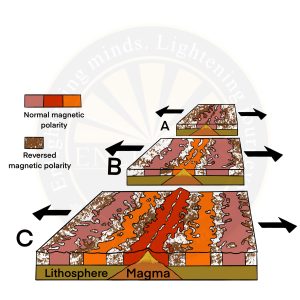
- Evidence from Magnetic Stripes
- Rocks that make up the ocean floor lie in a pattern of magnetising stripes that hold a record of the reversals in Earth’s magnetic field.
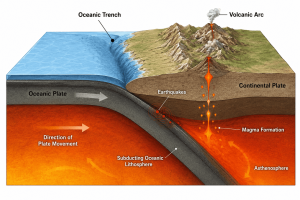
- Subduction
- Process by which the ocean floor sinks beneath a deep-ocean trench and back into the mantle; allows part of the ocean floor to sink back into the mantle.
Source: The Hindu