

Our Solar System consists of the Sun and eight planets (Mercury, Venus, Earth, Mars, Jupiter, Saturn, Uranus, Neptune), which are located in the Milky Way Galaxy.
- Mercury
- Mercury is closest to the Sun.
- It has a temperature range of 427ºC on its side facing the Sun and – 270ºC, on its dark side.
- It has no atmosphere.
- Mercury is smaller than the largest natural satellite in the Solar System, Ganymede (the largest moon of Jupiter).
- Venus
- It is the closest neighbour of the Earth.
- It is the hottest planet, with a temperature of 480ºC because the atmosphere has 96% carbon dioxide and poisonous gases like sulphur dioxide and carbon monoxide.
- It is the third brightest object visible from Earth after the Sun and the Moon.
- It is the brightest among planets because it has the highest albedo due to the highly reflective sulfuric acid that covers its atmosphere.
- Venus is sometimes called Earth’s sister planet or Earth’s twin because of their similar size, mass, proximity to the Sun, bulk composition, and presence of similar physical features.
- It rotates in the opposite direction (clockwise) to most other planets.
- Earth
- Earth is the only planet known to sustain life.
- Mars
- It is called the Red Planet because of the reddish iron oxide prevalent on its surface.
- It has 95% carbon monoxide and reddish dust.
- It is a relatively cold planet.
Outer Planets
- Jupiter
- It is the largest planet in the solar system.
- It is mainly a rapidly spinning ball of gas, especially clouds of ammonia, and has no solid surface.
- Jupiter’s four large moons (Io, Europa, Ganymede, and Callisto) are called the Galilean satellites because Galileo discovered them.
- Saturn
- It consists mainly of hydrogen and helium.
- Saturn’s density is even less than water.
- Its rings are made up of billions of ice particles and ice-covered rocks.
- Titan is its largest satellite.
- Uranus
- It is also a very cold planet.
- Uranus is a distant planet in the solar system and is 7th in order from the Sun.
- Uranus and Neptune are the outermost planets of the solar system.
- Uranus has a highly tilted rotation axis.
- Neptune
- Neptune is cold and dark, with its surface coated with frozen methane.
- It is the furthest of the planets in our solar system.
- It is more than 30 times as far from the Sun as Earth is.
- Neptune is very similar to Uranus. It’s made of a thick fog of water, ammonia, and methane over an Earth-sized solid centre.
- Its atmosphere is made of hydrogen, helium, and methane.
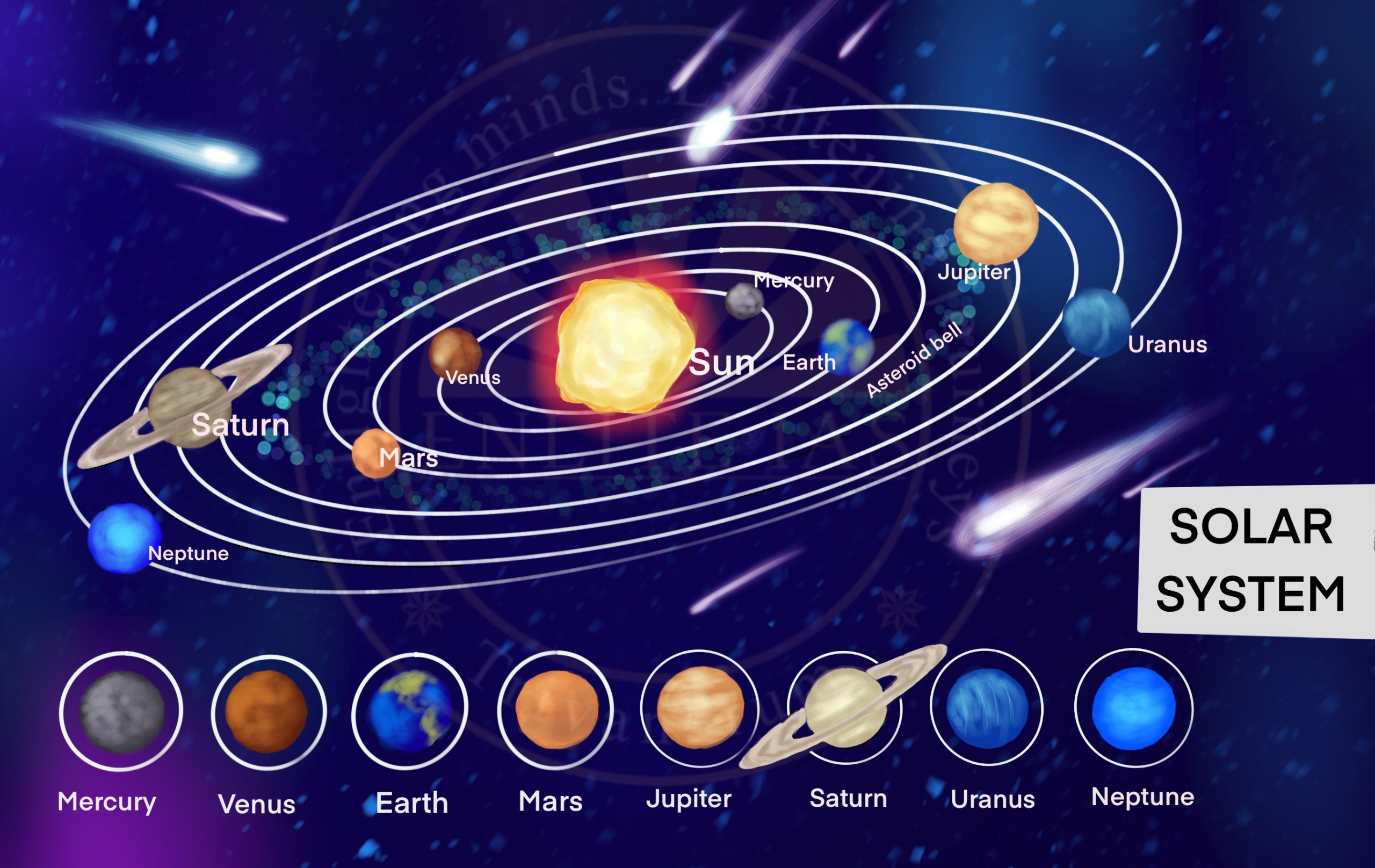
Source: The Hindu