

UNCLOS is an international treaty that establishes the legal framework for marine and maritime activities.
- Also called the law of the sea
- Adopted in 1982 and came into force in 1994.
- Aim to ensure peaceful use of oceans, equitable use of marine resources, protection of the marine environment, and regulation of maritime boundaries.
- Creates the International Seabed Authority (ISA) to regulate mineral resources in areas beyond national jurisdiction.
- There are 168 members, including the European Union.
UNCLOS Division of Maritime Zone
- Internal Waters: Internal waters are waters on the landward side of the baseline from which the breadth of the territorial sea is measured. Each coastal state has full sovereignty over its internal waters as like its land territory. For example ports, bays etc.
- Territorial Sea (Up to 12 nm): The state exercises sovereignty over the water, seabed, subsoil, and airspace. Other nations’ ships enjoy the right of innocent passage.
- Contiguous Zone (Up to 24 nm): Extends another 12 nm beyond the territorial sea. The state may exercise control to prevent and punish infringements of its customs, fiscal, immigration, or sanitary laws.
- Exclusive Economic Zone – EEZ (Up to 200 nm): The state has sovereign rights over exploring, exploiting, conserving, and managing natural resources (fish, oil, gas) in the water column and seabed. Other nations have freedom of navigation.
- High Seas (Beyond EEZ): Waters not included in any state’s EEZ, territorial sea, or internal waters. It is considered the “common heritage of all mankind,” where freedom of navigation, overflight, fishing, and scientific research applies.
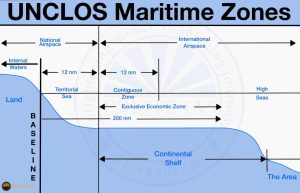
Source: The Indian Express