Basics
- About 71% of the Earth’s surface is covered by water.
- Oceans form a single, large, continuous body of water encircling all the landmasses of the Earth.
- They account for four-fifths of the Southern Hemisphere and three-fifths of the Northern Hemisphere.
- They contain 97.2 percent of the world’s total water.
- There are five principal oceans in the world – the Pacific Ocean, the Indian Ocean, the Atlantic Ocean, the Arctic Ocean, and the Southern Ocean.
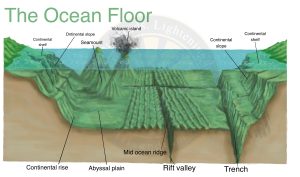
Major Ocean Relief Features
- Continental Shelf
- Continental Shelf is the gently sloping seaward extension of continental plates.
- Shallow seas and gulfs occupy the extended margin.
- Continental Shelf of all oceans together covers 7.5% of the total area of the oceans.
- The gradient of continental shelf is 1° or even less.
- The shelf typically ends at a very steep slope, called the shelf break.
- The continental shelves are covered with variable thicknesses of sediments brought down by rivers, glaciers etc.
- It is a major source of fossil fuels and fishing. For example – Continental Shelf of South-East Asia, Great Banks around Newfoundland, Submerged region between Australia and New Guinea.
- Continental Slope
- Continental slope is the slope between the outer edge of the continental shelf and the deep ocean floor.
- The continental slope is cut by submarine canyons in many locations.
- The gradient of the slope region varies between 2-5°.
- It extends between depths of 180 to 3600 metres.
- Along the base of the continental slope is a deposit of sediments. This belt of sedimentary deposits form the continental rise.
- In some regions the rise is very narrow but in others it may extend up to 600 km in width.
- For example – slope off the shore of the Philippines.
- Continental Rise
- The continental slope gradually loses its steepness with depth.
- When the slope reaches a level of between 0.5° and 1°, it is referred to as the continental rise.
- For example – Amazon Cone
- Deep Sea Plains or Abyssal Plains
- Deep sea planes are gently sloping areas of the ocean basins.
- These are the flattest and smoothest regions of the world.
- It covers nearly 40% of the ocean floor.
- The depths vary between 3,000 and 6,000 m.
- These plains are covered with fine-grained sediments like clay and silt.
Minor Ocean Relief Features
- Trenches
- The trenches are relatively steep-sided, narrow basins.
- They are of tectonic origin and are formed during ocean – ocean convergence and ocean-continent convergence.
- They are some 3-5 km deeper than the surrounding ocean floor.
- The trenches run parallel to the bordering-fold mountains or the island chains.
- For example – Mariana Trench off the Guam Islands in the Pacific Ocean is the deepest trench with a depth of more than 11 kilometres.
- Mid-Oceanic Ridges
- A mid-ocean ridge is a seafloor mountain system formed by divergent plate boundaries.
- It typically has a depth of about 2,600 metres and rises about 2,000 metres above the deepest portion of an ocean basin.
- Seamount
- A seamount is an underwater mountain formed by volcanic activity and it does not reach the surface of the ocean.
- Height is 3,000-4,500 m.
- For example – Emperor seamount, an extension of the Hawaiian Islands in the Pacific Ocean.
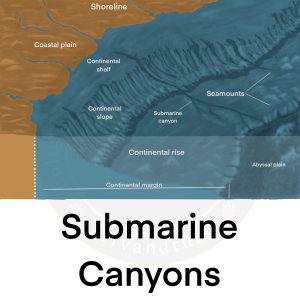
- Submarine Canyons
- A submarine canyon is a steep-sided valley cut into the seabed of the continental slope.
- For example – Hudson Canyon
- Guyots
- Guyot, also known as a tablemount, is an isolated underwater volcanic mountain with a flat top more than 200 m below the surface of the sea.
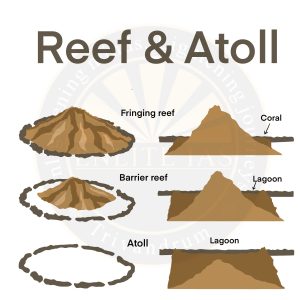
- Atoll
- An atoll is a ring-shaped coral reef, including a coral rim that encircles a lagoon partially or completely.
- Banks
- A bank is a flat-topped elevation located in the continental margins.
- The banks are sites of some of the most productive fisheries of the world.
- For example – Dogger Bank in the North Sea and Grand Bank in the north-western Atlantic.
- Shoal
- A shoal is a detached elevation with shallow depths. Since they project out of water with moderate heights, they are dangerous for navigation.
- Reef
- A reef is a predominantly organic deposit made by living or dead organisms that form a mound or rocky elevation like a ridge.
- Since the reefs may extend above the surface, they are generally dangerous for navigation.
- For example – the largest reef in the world is found off the Queensland coast of Australia.