

Demand of the question:
- Create points on how accountability can lead to economic progress.
- While brainstorming the dimensions on this try to link accountability with other aspects of good governance like transparency, efficiency, participatory governance and inclusivity.
- Before that you can just enlist reasons for underutilization for resources as well for setting a background.
Introduction
In 2026, India has become a $4 trillion economy by maintaining a strong and consistent real GDP growth rate. It is practically possible for India to become the third largest economy quickly by emphasizing upon the pillars of good governance, in particular through accountability for proper use of its resource potential.
Need for effective resource utilisation
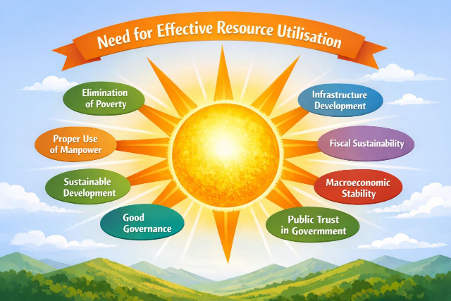
Key Challenges in Resource Utilisation (3 or 4 points)
- Populist Policies – Short-term give-aways crowd out productive capital expenditure. Eg: farm loan waivers instead of agri investments.
- Capacity deficits due to weak planning and absorption capacity at local levels. Eg: own funds account for only 30% of total revenue of ULBs.
- Process delays on account of land acquisition, clearances, and tendering bottlenecks.
- Leakages & inefficiency due to ghost beneficiaries and inflated procurement. Eg: about 28% of subsidised grains supplied through PDS do not reach the intended beneficiaries..
- Centre–State Mismatch – Coordination gaps in scheme implementation. Eg: ayushman bharat scheme overlap with state level insurance schemes.
- Outcome blindness – Focus on spending targets rather than results. Eg: according to previous CAG reports, 50-60% of local devt. funds were spent in the last quarters leading to poor quality projects.
- Accountability gaps – Limited post-expenditure scrutiny.
Mechanisms to Ensure Effective Utilisation
(#Mention 5,6 of these points with short egs taking into account time constraints in the exam hall as well)
- Outcome-based budgeting – linking funds to measurable results. Eg: under PM Gram Sadak Yojana, states must submit geo-tagged evidence of roads constructed before the next tranche is released.
- Moving from rule based to role based approach and continuous capacity building of officials. Eg: Mission Karmayogi
- Digital governance for transparency. Eg: DBT, PFMS, real-time dashboards
- Social audit based accountability for more participatory governance. Eg: NFSA, MGNREGA
- Ensuring checks and balances through Weberian model for upholding rule of law. Eg: CAG & legislative oversight for independent scrutiny.
- Decentralised planning along the lines of Gandhian gramswaraj. Eg: people’s plan campaign.
- Deterrence against mismanagement through legislations like Prevention of Corruption Act. Eg- Kautilya’s dandaniti
- Time-bound clearances to prevent cost overruns. Eg: Citizen’s Charter for more efficiency.
- Principle of incentivisation in public administration. Eg: performance-linked incentives as in Singapore model..
- Participatory governance through tools like RTI and open data portals. Eg – Adarsh and Commonwealth scam, exposed through RTI
- Role of Corporates through following the ethical principles of ESG. Eg – Vision of Ratan Tata
Conclusion
Following the fundamental duties, if citizens strive for individual and collective well-being complimented by an evolving administrative system, it can transform India’s inherent potentials into reality of becoming a huge economic power in the near future.