

Demand of the question:
The question demands an analytical examination of different aspects of developmental ethics broadly and integrating them with national security challenges. Briefly mention various suggestions before concluding.
(# In the real time, try to maximise and prioritise the dimensions (5 in dilemma part + 4 in suggestions) and micro egs in some points (not possible under all points within the time limit )
Introduction:
Development projects in ecologically sensitive border areas raise a complex ethical dilemma involving environmental ethics, developmental ethics, and international ethics. These dilemmas must be resolved by prioritising long-term national interest rooted in humanistic values, rather than short-term strategic gains.
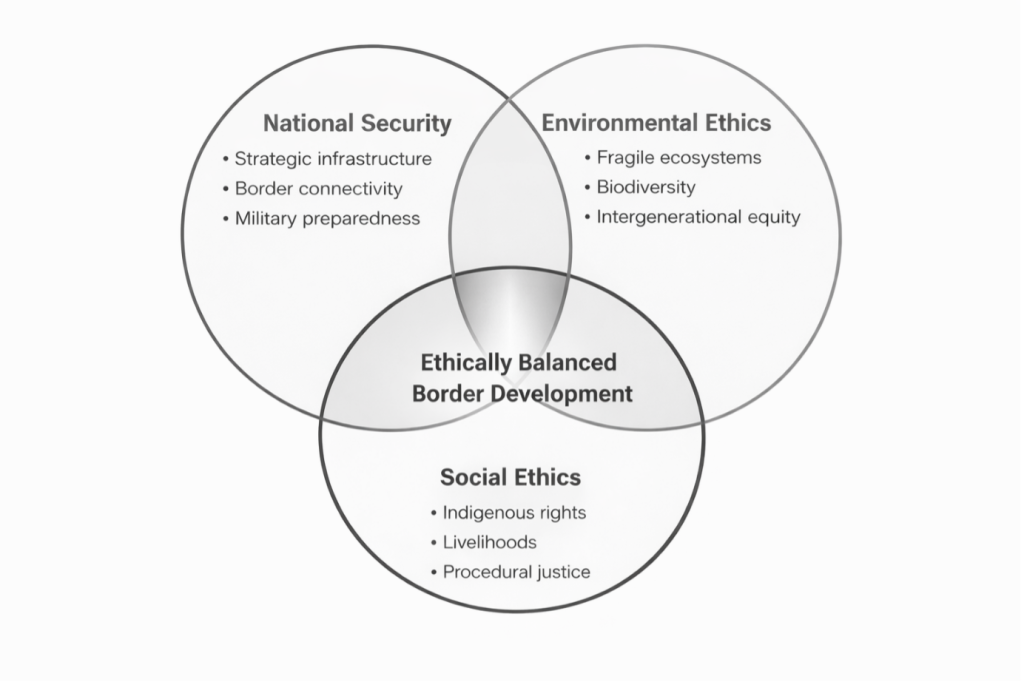
Ethical Dilemmas Involved
- Intergenerational & Intragenerational Equity: Unsustainable resource use (hill road blasting) leads to ecological loss, protests, livelihood erosion, and long-term insecurity. Eg: Moreh border trade skewed towards external traders.
- Rehabilitation and cultural ethics: Displacement of indigenous border communities can cause cultural conflicts and social. Eg: Adi communities and Siang Upper Multipurpose Project in Arunachal Pradesh.
- Human–Animal Conflict: Wildlife displacement due to developmental projects increases attacks near border villages, creating internal security stress. Eg: Siliguri–Kharibari elephant corridor disruption.
- International Ethics: Ecological spillovers across borders such as glacier destabilisation or river sedimentation from infrastructure projects may violate peace and environmental commitments. Eg: Farakka Barrage–Bangladesh downstream impact
- Internal Security Risks: Discontent arising from environmentally harmful projects can be exploited by hostile nations or fuel insurgency and infrastructure sabotage. Eg: Kuki protests over India–Myanmar fencing.
- Disaster Ethics & Human Security: Construction in fragile border ecosystems increases vulnerability to landslides, avalanches, and floods, ethically risking civilian lives and the safety of security personnel deployed in these regions. Eg: Mana glacier avalanche, Uttarakhand
Mechanisms for Ethical Resolution
- Environmental Protection Act & EIA framework: Environmental clearances must be grounded in rigorous, science-based and participatory clearances. Eg: Cumulative impact studies in Alaknanda–Bhagirathi basin..
- Forest Rights Act (FRA): Developmental activities requires prior informed consent of forest-dwelling and tribal communities, to reduce alienation and associated security risks. Eg: Gram Sabha consent debates in Arunachal Pradesh.
- Judicial Oversight: Supreme Court and National Green Tribunal scrutiny in ecologically sensitive zones can uphold objectivity in decision making.
Eg: NGT stay on Manipur ring road.
- Sustainable and innovative design: Adoption of tunnelling instead of surface roads, green corridors for wildlife, disaster-resilient infrastructure, and mitigation measures minimises ecological damage while meeting strategic and defence requirements. Eg: Sela Tunnel in Arunachal Pradesh provides all-weather, less ecologically disruptive connectivity.
- Adaptive Governance & Monitoring: Continuous post-clearance monitoring, social audits, and technology-based surveillance help detect ecological damage and security risks. Eg: GIS-based Himalayan land-use tracking
- Security–Environment Coordination: Institutional coordination between defence agencies, environmental authorities, and local administrations ensures development safe and startegic. Eg: MoD–MoEFCC protocols in Ladakh.
Conclusion:
Beyond ethical ideals of minimalism and biocentrism, such scenarios demand a strategic, innovative, and pragmatic approach—one that safeguards enlightened national interest by harmonizing security, sustainability, and justice.