

Causes of the Revolt
- Economic Causes
- Heavy taxation on people.
- Deteriorating economic conditions.
- Use of quo warranto in the case of land.
- The confiscation of estates made old zamindars poor.
- Political Causes
- Annexation of Awadh due to misgovernance.
- Introduction of policies like subsidiary alliance and the doctrine of lapse.
- Administrative Causes
- Corruption among officials.
- Absentee sovereignty.
- Socio-Religious Causes
- Racial discrimination.
- Activities of Christian missionaries.
- Attempts at socio-religious reforms, such as the abolition of sati, the Widow Remarriage Act, and women’s education.
- Passage of the Lex Loci Act.
- Influence of Outside Events
- Anglo-Afghan War.
- Santhal rebellion.
- Punjab War.
- Military Causes
- Introduction of new Enfield rifles.
- Abolition of religious symbols in the army.
- Lord Cannings General Service Establishment Act
- Issues of foreign allowance.
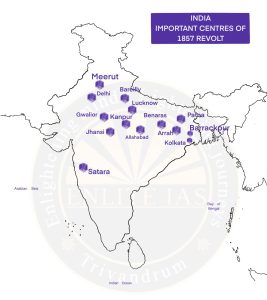
Main Centers of Revolt
| Place | Leader | Suppressed by |
| Delhi | General Bhakt Khan | Lt. Willoughby
John Nicolson Lt. Hudson |
| Kanpur | Nana Sahib
Tantia Tope |
Sir Hugh Wheeler
Sir Colin Cambell |
| Lucknow | Begum Hazrat Mahal | Henry Lawrence
Henry Havelock Sir Colin Cambell |
| Jhansi | Rani Laxmibai | Sir Hugh Rose |
| Baraily | Khan Bahadur | |
| Bihar | Kunwar Singh | |
| Faizabad | Maulavi Ahmadullah |
Reasons for Failure
- Lack of spirit of nationalism.
- Lack of support from the middle-class intelligentsia.
- Lack of coordination and unity.
- Lack of resources and planning.
- Lack of proper leadership and weak leaders like Bahadur Shah.
Effects of the Revolt
- Abolition of the Company Act by the Government of India Act, 1858.
- Ensure Indian participation in governance.
- Reversal of the policy of annexation of princely states.
- Introduced the divide and rule policy.
- Introduction of a new office called the Secretary of State.
- The office of the Governor-General was replaced by the viceroy.
- Lenient policy towards peasants and zamindars.
- The army was reorganised on caste lines.
- Racial hatred deepened.
- Ended the dual system.
Source: The Indian Express